
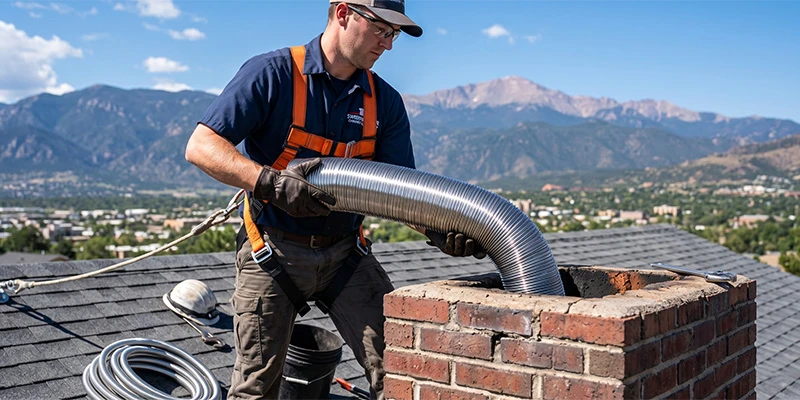
When you look at your chimney from the outside, you see a strong tower of bricks. But the most important part of your chimney is actually hidden inside. It is called the chimney liner.
Many homeowners in Colorado Springs do not know what a liner is until a chimney sweep tells them it is broken. A damaged chimney liner is a major fire hazard. If your liner is cracked or missing, you should not use your fireplace.
This simple guide will explain exactly what a chimney liner does, why it breaks, and how we fix it. We want to help you understand your chimney so you can keep your family safe.
What Exactly is a Chimney Liner?
Think of your chimney as a thick brick tunnel. The chimney liner is a smaller, protective tube that runs all the way down the inside of that tunnel. The smoke from your fire travels through this inner tube to get outside.
In older homes, chimneys were sometimes built without liners. The smoke just touched the bare bricks. Today, modern safety codes require every chimney to have a proper liner. It is an absolute necessity for safe heating.
3 Reasons You Must Have a Liner
A chimney liner performs three very important jobs to protect your house.
1. It Protects Your House from Catching Fire
A wood fire burns extremely hot. If you do not have a liner, that intense heat can travel straight through the brick chimney walls. It can reach the wooden framing of your house. A liner acts like a heat shield. It keeps the extreme heat safely contained inside the chimney so your wooden walls do not catch on fire.
2. It Protects the Bricks from Acid
When wood burns, it creates smoke and gases. These gases contain harmful, corrosive acids. If these gases touch bare bricks and mortar, the acid eats away at the cement. Over time, the cement crumbles and the chimney loses its strength. A liner protects the bricks from this toxic smoke.
3. It Helps the Smoke Escape Faster
A chimney works best when it is the exact right size for the fireplace. If the chimney tunnel is too big, the smoke cools down too quickly and slows down. A proper liner creates a smooth, correctly sized pathway. This helps the hot smoke rise fast and exit your home quickly.
Signs Your Chimney Liner is Damaged
Because the liner is hidden inside the chimney, you cannot see it from your living room. However, there are a few warning signs that your liner might be failing.
- Crumbling Clay in the Firebox: Many older liners are made of clay tiles. If these tiles crack, small pieces of orange clay might fall down into your fireplace. If you see broken clay chunks mixed with your ashes, your liner is falling apart.
- Smoke in the House: A cracked liner can leak smoke into the walls or the upper floors of your home. If you smell smoke in a bedroom directly above the fireplace, you have a leak.
- Water Leaks: If rain gets into your chimney, it can mix with soot and leak through a cracked liner. You might see dark, smelly water stains on the walls near the fireplace.
Why Do Liners Break?
In Colorado Springs, the most common type of liner in older homes is the clay tile liner. Clay is very tough, but it has a major weakness: rapid temperature changes.
When you light a hot fire on a freezing winter night, the clay heats up too fast. This thermal shock causes the clay to split and crack. Also, if water gets inside your chimney and freezes, the expanding ice can shatter the clay tiles. Even one small crack makes the entire liner unsafe to use.
Another major cause of damage is a chimney fire. If the sticky soot (creosote) inside your chimney catches on fire, the extreme heat will instantly destroy a clay liner.
How Do We Inspect the Liner?
The only way to truly know if your liner is safe is to look at it from the inside. You cannot do this with a regular flashlight.
When you schedule a professional chimney inspection, we use a special video camera. We lower the camera on a long cable all the way down the chimney flue. We watch the video on a monitor in your living room. This lets us see every inch of the liner. We look for cracks, missing mortar, and dangerous gaps. We will always show you the video so you can see the condition of your chimney with your own eyes.
The Best Solution: Stainless Steel Liners
If your old clay liner is cracked, we cannot just glue it back together. The safest and most effective way to fix the problem is to install a brand new stainless steel liner.
A stainless steel liner is a long, flexible metal tube. We slide this tube all the way down the chimney, from the roof down to the fireplace. Here is why stainless steel is the best choice:
- It is Seamless: Because it is one continuous piece of metal, there are no joints or gaps for smoke to leak through.
- It Cannot Crack: Unlike clay, stainless steel handles extreme heat and freezing cold perfectly. It will never crack from thermal shock.
- It is Easy to Clean: Creosote does not stick as easily to smooth stainless steel, making your yearly sweep much faster and more effective.
We often wrap the new stainless steel liner in a special insulation blanket before we put it in the chimney. An insulated liner keeps the smoke incredibly hot so it vents perfectly.
Conclusion
Your chimney liner is the heart of your fireplace safety system. You should never guess if it is in good condition. Using a fireplace with a cracked liner is playing a dangerous game with your home.
If you live in an older home, or if you have never had a video inspection, now is the time to act. Our professional chimney repair team in Colorado Springs can inspect your flue and install a lifetime-warrantied stainless steel liner if needed.
Keep your family safe and warm this winter. Give us a call to book your camera inspection today. For more information on safe venting, you can visit the CSIA or NFPA websites.