
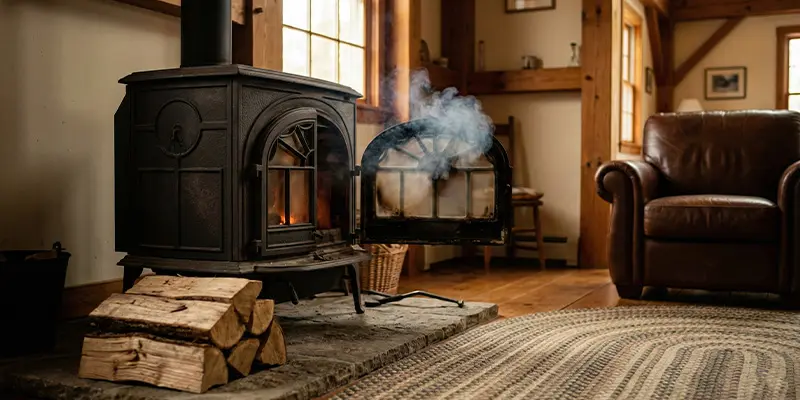
You light your wood stove, looking forward to a warm evening. But suddenly—PUFF. A cloud of gray smoke bursts out of the stove and into your living room. Instead of a cozy fire, you are coughing and opening windows.
This is called back puffing. It happens when smoke travels down the chimney instead of up. It is frustrating, smelly, and can set off your smoke alarms.
Why does it happen? Usually, it is a battle between hot air and cold air. Here are the main reasons your wood stove puffs smoke and how to fix them.
1. The “Cold Air Plug” (Most Common)
Hot air rises. But cold air sinks. If your wood stove has not been used for a while, the air inside the chimney flue is cold and heavy. This cold air acts like a cork or a plug. It blocks the smoke from going up.
When you light a fire, the weak heat from the match hits that heavy block of cold air. It cannot push through, so the smoke spills back into the room.
The Fix: “Prime” the Flue.
Before you light your logs, you need to warm up the chimney.
1. Roll up a piece of newspaper into a torch.
2. Light it and hold it up inside the stove, near the flue opening.
3. Hold it there for a minute until you feel the draft reverse (the air starts sucking up).
4. Now light your fire. The chimney is primed and ready to draw smoke up.
2. The House is Too Airtight (Negative Pressure)
Your wood stove needs air to breathe. But modern homes in Colorado Springs are built to be airtight to save energy. If you run your kitchen hood, bathroom fans, or clothes dryer, they suck air out of your house.
If no fresh air can get back in, your house tries to suck air down the chimney to balance the pressure. This pulls the smoke right into your living room.
The Fix: Give it air.
Crack a window near the stove just an inch before you light the fire. This gives the fire the oxygen it needs without fighting your house for air. Once the fire is roaring hot, you can usually close the window.
3. The Wind is Blowing Down
We get strong winds in Colorado Springs. If the wind blows over your roof and hits a tall tree or a nearby building, it can swirl downward. This pushes air right down your chimney.
The Fix: Check your cap.
You might need a special wind-directional chimney cap. These caps turn with the wind to block downdrafts. Also, make sure your chimney is tall enough. It needs to be higher than the peak of your roof to catch the wind correctly.
4. The Wood is Wet
Wet or “green” wood does not burn hot. It smolders and creates a lot of heavy, cool smoke. This cool smoke doesn’t have the energy to rise quickly up the chimney. It lingers in the stove and puffs out whenever the wind changes.
The Fix: Check your fuel.
Only burn dry, seasoned wood. Bang two logs together. If they make a dull “thud,” they are wet. If they make a sharp “clink” sound, they are dry and ready to burn.
5. The Chimney is Dirty
If your chimney is clogged with soot or creosote, the smoke has nowhere to go. It is like trying to breathe through a straw that is pinched shut. The smoke will back up and puff out the door.
The Fix: Clean it out.
If you have tried the other fixes and it still puffs smoke, you likely have a blockage. You need a professional chimney cleaning. We can remove the soot, bird nests, or debris blocking the flow.
Conclusion
Back puffing is messy, but you can usually stop it. Remember to warm up your flue, use dry wood, and make sure your chimney isn’t clogged.
If you are tired of the smoke and these tips don’t help, give us a call. We can check your system for blockages or design problems. Let’s keep the smoke outside where it belongs.