
Fireplace Cleaning in Colorado Springs - Full Interior Service
Full Interior Fireplace Cleaning Completed Before Your First Fall Fire
Smoke shelf and smoke chamber included - not just the firebox floor
- CSIA-certified technicians
- Smoke shelf included
- Every surface documented
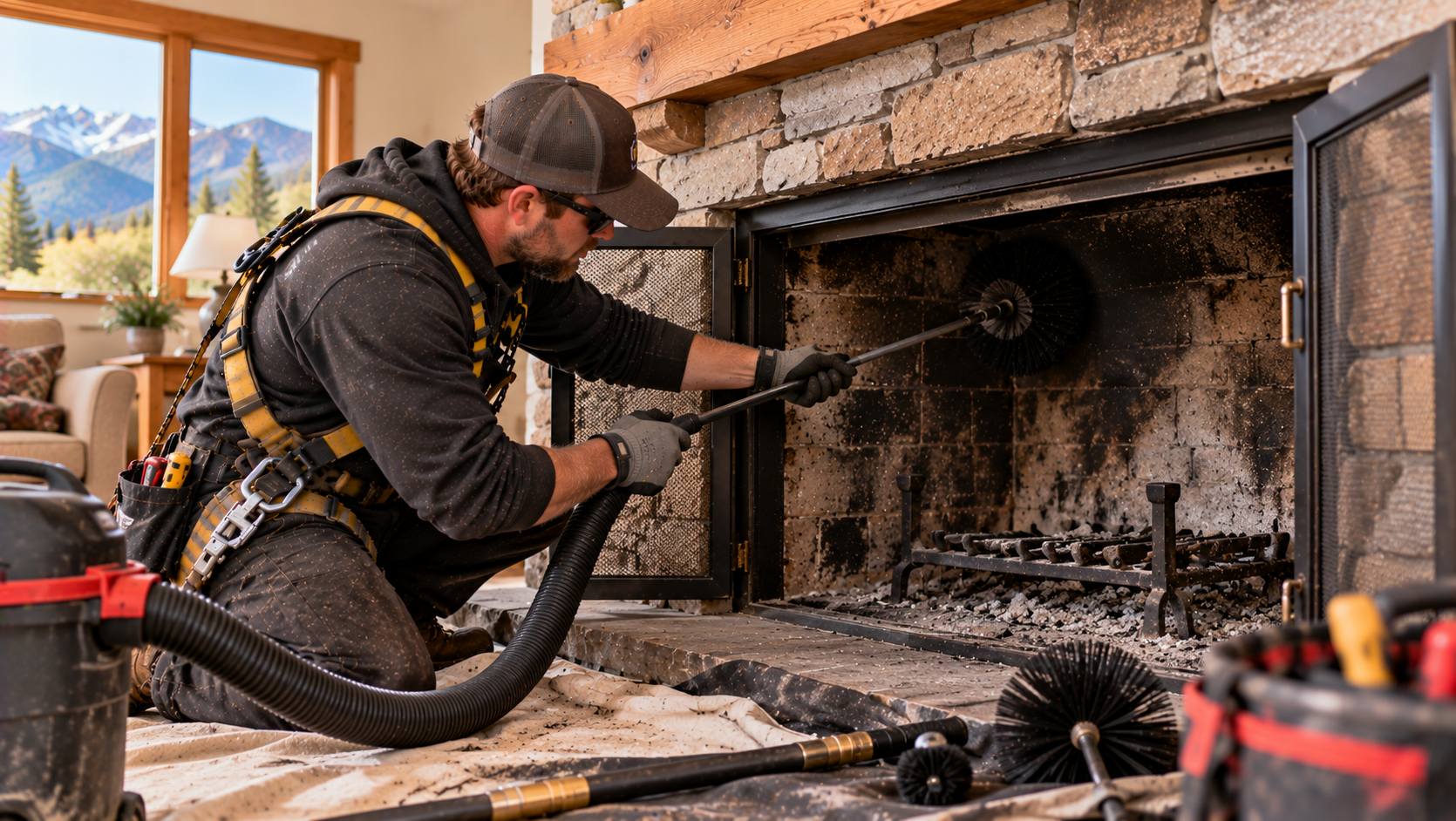
Complete Fireplace Cleaning in Colorado Springs Covers Every Surface That Matters
A full interior fireplace cleaning addresses the firebox, smoke shelf, smoke chamber, and glass - in one appointment.
Most homeowners picture the firebox - the combustion chamber where wood actually burns - when they think about cleaning a fireplace. That's one piece of it. The firebox walls and floor collect soot, ash, and creosote with every fire. The surfaces above the firebox matter just as much.
The smoke shelf - a horizontal ledge sitting directly behind the damper, above the firebox opening - catches condensed creosote and falling debris throughout the heating season. The smoke chamber, the tapered cavity above the shelf that funnels combustion gases toward the flue, builds up residue that directly affects how well your fireplace draws.
A complete fireplace cleaning in Colorado Springs from Chimney Sweep Colorado Springs covers all of it. Firebox walls and floor. Smoke shelf. Lower smoke chamber. Glass doors. Ash removal. Every surface documented before the technician closes the service call.
5-6 moOf weekly fires, October through March
Colorado Springs Homes Push Their Fireplaces Hard Through a Long Heating Season
Colorado Springs' elevation and dry winters mean local fireplaces work harder - and collect residue faster - than most.
Here's what most homeowners don't realize about burning wood at 6,035 feet above sea level. At that elevation, the air is thinner. That affects combustion directly. Wood fires at altitude tend to run slightly oxygen-lean, which increases the amount of combustion byproducts - ash, soot, and creosote - deposited per fire compared to lower-elevation cities.
The heating season here runs long. Fireplaces in Briargate, Rockrimmon, Black Forest, and the west side neighborhoods near the foothills often see regular use from early October through late March. That's five to six months of weekly fires, sometimes more during cold stretches. Fountain, Security-Widefield, and Cimarron Hills see similar use patterns.
By the time spring arrives, those fireplace interiors have been working hard for months. Sitting through summer allows residue to bake into firebox walls and the smoke shelf. When the next fall arrives, the fireplace is already carrying last year's load.
NFPA 211 - the National Fire Protection Association's standard for chimneys and fireplaces - calls for annual inspection, with cleaning done as needed. For Colorado Springs homes burning wood regularly, that annual cadence isn't a formality. It's practical maintenance.
What We Find When We Open Up a Fireplace That's Been Running All Season
Opening up a fireplace that's burned wood through a Colorado Springs winter reveals a lot - and what we find on the smoke shelf often surprises homeowners.- Chimney Sweep Colorado Springs Technician Team
One service call I think about happened in late September, right before the heating season kicked in. The homeowner at a Black Forest property had been burning two or three nights a week for the past four winters. She called because the fireplace had started to smell off - not smoke, exactly, but something musty when the wind shifted.
- 1The smoke shelfI opened the damper and checked the smoke shelf first. It had a thick layer of condensed creosote - stage-one deposits mostly, but packed tight across the full width of the shelf. That's dried, flaky creosote that looks almost like soot. It had been building for at least two full seasons without being cleared.
- 2The firebox wallsBelow it, the firebox walls had a moderate soot coat.
- 3Last spring's ashThe firebox floor still had ash from the previous spring. Ash removal matters more than people expect. Ash left for months traps moisture from humidity swings - and in Colorado Springs, you get real humidity variance between July monsoon season and the dry winter months. That moisture accelerates deterioration of the firebox floor over time.
- 4The glass doorsThe fireplace glass doors were nearly opaque from soot deposits. That kind of buildup doesn't just look bad. It reduces the radiant heat that comes through the glass into the room.
- 5A crack worth trackingWe also noted some minor mortar cracking on the firebox back wall - nothing urgent, but worth tracking. We documented it and flagged it for the homeowner before we left.
We cleaned the smoke shelf, the lower smoke chamber, the firebox walls and floor, removed the ash, and cleaned the glass. The whole job took about 90 minutes. That's the full picture. Not just a vacuumed firebox floor.
Scheduling a Cleaning Before the Season Means You Start Without Uncertainty
Booking fireplace cleaning in Colorado Springs before October gives you a clean system for the whole season - no surprises mid-winter.
A question we hear often is whether it's better to clean at the end of the season or the beginning. Either timing works, but pre-season is easier to plan around.
If you burned heavily last season and didn't clean in spring, booking before that first October fire is the right call. Combustion byproducts - the mix of ash, soot, and creosote produced by wood fires - left from the previous year don't improve on their own. They concentrate on the smoke shelf and smoke chamber walls through the off-season. Starting the new season with a documented, clean interior means you know exactly what you're working with.
Chimney Sweep Colorado Springs is CSIA certified - the Chimney Safety Institute of America trains and credentials our technicians to follow defined protocols. That standard applies to fireplace cleaning the same way it applies to inspection and relining.
Pre-season (September or early October)
- A technician is already inside the fireplace
- Condition changes noted before the first fire
- The right call if you burned heavily and skipped spring
Late-season (April or May)
- Removes residue before it sits all summer
- Protects surfaces during the warm months
Our Fireplace Cleaning Standards - What "Full Interior" Actually Means
Every complete fireplace cleaning in Colorado Springs follows a documented, surface-specific scope - no skipped areas.
- Firebox walls and floor: Soot and stage-one creosote removal from all combustion chamber surfaces. We work top-to-bottom to avoid recontaminating surfaces already cleaned.
- Smoke shelf: Full clearing of condensed creosote, debris, and any animal material. This is the surface most often missed in a partial cleaning.
- Lower smoke chamber: Residue removal from the tapered section above the smoke shelf. Buildup here constricts airflow and contributes to draft problems.
- Ash removal: Complete clearing of ash accumulation from the firebox floor. We contain and remove it - no mess left in the firebox.
- Fireplace glass doors: Soot and residue cleared from tempered glass panels. Clean glass restores heat radiation and gives you a clear view of the fire.
- Condition documentation: Every surface noted with current status before the technician leaves. Findings are reported to the homeowner before the service call closes.
CSIA certification governs the scope. Every step follows structured protocol.
How We Execute a Full Interior Fireplace Cleaning
Pre-Cleaning Diagnostics
The technician starts with a visual check. Damper operation is confirmed. The smoke shelf is inspected with a light before cleaning begins - this tells us what we're working with and flags any conditions that affect how we proceed. Glass door condition is noted. Ash depth on the firebox floor is estimated. This pre-cleaning check is a baseline read before tools go in. It is not a formal inspection in the NFPA 211 sense.
Surface-by-Surface Cleaning
Ash removal happens first. We contain the ash at the firebox floor before anything above it is disturbed. Then we work from the smoke chamber downward - chamber walls, then smoke shelf, then firebox walls, then the firebox floor again. Working top-to-bottom matters. Debris from upper surfaces falls to lower ones during cleaning, so sequence controls the final result. Glass doors are cleaned last, after the firebox is fully cleared. Tempered fireplace glass requires appropriate cleaning compounds - not household glass cleaner, which can leave residue under heat.
Post-Service Documentation
Before we pack equipment, we document what we found and what we cleaned. Notable conditions - mortar cracking, smoke shelf wear, glass door seal issues, early-stage creosote on the smoke chamber walls - are noted and communicated to the homeowner. If anything warrants a formal inspection, we say so directly. The homeowner leaves with a clear record of their fireplace's condition. Not just "it's clean." A real account of what was there and what was done.
Areas We Serve in and Around Colorado Springs
Chimney Sweep Colorado Springs provides complete fireplace cleaning throughout the greater Colorado Springs metro and surrounding communities.
- Colorado Springs
- Briargate
- Rockrimmon
- Falcon
- Black Forest
- Monument
- Fountain
- Security-Widefield
- Cimarron Hills
- Stratmoor
- Manitou Springs
- Woodland Park
- Pueblo
- Castle Rock
- Parker
We serve Colorado Springs neighborhoods including Briargate, Rockrimmon, Falcon, Black Forest, and Monument to the north. Fountain, Security-Widefield, Cimarron Hills, and Stratmoor to the south. Manitou Springs and Woodland Park to the west. We also serve Pueblo, Castle Rock, Parker, and communities across the Pikes Peak Region.
Schedule Your Complete Fireplace Cleaning in Colorado Springs
Clean interior surfaces, documented condition, and a fireplace ready for the season - that's the goal of every service call.
Call Chimney Sweep Colorado Springs at (720) 505-5030 or email info@chimneysweepscoloradosprings.com to schedule. Tell us your fireplace use pattern and the last time it was cleaned - we'll get you on the schedule.
Frequently Asked Questions
Call and talk to the team directly.
Call (720) 505-5030Fireplace cleaning scope varies by surface condition, creosote stage, and whether glass doors are included. Contact Chimney Sweep Colorado Springs at (720) 505-5030 for an accurate quote based on your fireplace's use history and last cleaning date.
Every surface gets cleaned - firebox walls and floor, smoke shelf, lower smoke chamber, glass doors, and ash removal in one visit. The smoke shelf is the most commonly skipped area in incomplete cleanings. Our CSIA-certified technicians follow a top-to-bottom sequence so nothing cleaned above recontaminates what's below.
Most full interior fireplace cleanings take approximately 90 minutes. That includes pre-cleaning diagnostics, surface-by-surface cleaning, glass door treatment, and post-service documentation. Heavily built-up smoke shelves or thick ash accumulation may add time.
Ash traps moisture. Over summer months, humidity swings in Colorado push moisture into ash sitting on the firebox floor. That trapped moisture accelerates deterioration of the firebox floor material over time. Removing ash completely is part of every full interior cleaning we perform.
Yes - every service call closes with documented findings. Each surface area is noted with its current condition. If the technician spots mortar cracking, glass seal issues, or early-stage creosote on the chamber walls, those findings are communicated before the job closes. You leave with a clear record, not just a verbal summary.
Musty odor when wind shifts often points to creosote buildup on the smoke shelf or chamber walls, not a structural problem. A full interior cleaning removes the residue causing the smell. If odor continues after cleaning, that signals a draft issue worth investigating separately - we note that possibility before we leave.