
Chimney Mortar Repair & Repointing in Colorado Springs
Mortar Mix Matched, Joints Raked & Packed to Correct Depth
Wrong mortar splits bricks - we match mix to your masonry before starting.
- CSIA-certified technicians
- Raked to 3/4" minimum
- Mix matched to your brick
What Chimney Repointing Involves
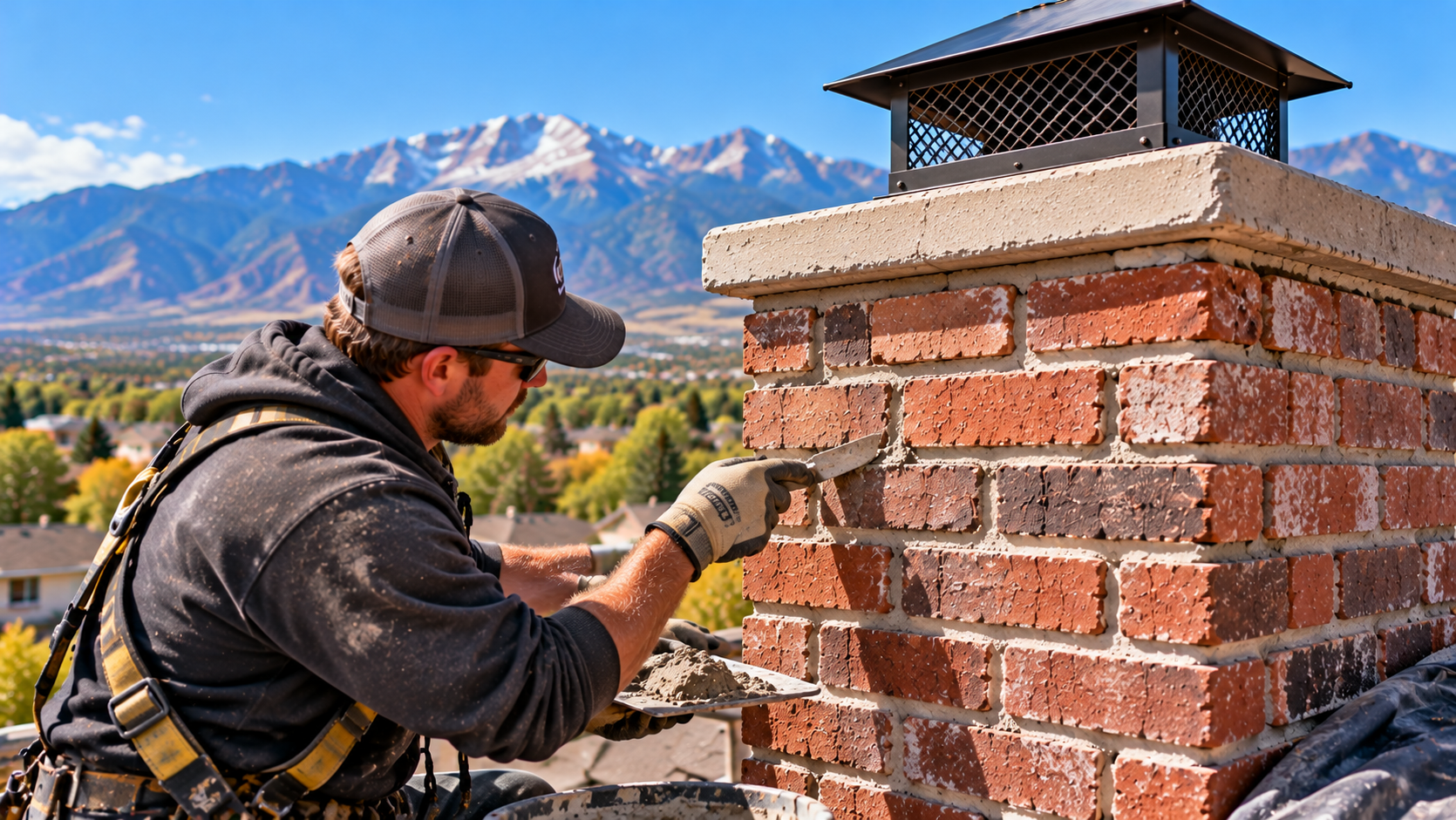
Chimney repointing in Colorado Springs is the process of removing deteriorated mortar from between your brick courses and packing new mortar in its place.
That new mortar has to be the right mix for your specific chimney - not too hard, not too soft. Get the mix wrong and the surrounding brick faces can crack right off the wall.
Our CSIA-certified technicians select the mortar type before any work begins, based on your chimney's age, brick hardness, and current joint condition.
40°Temperature change within a single day
Colorado Springs Chimneys Face Real Joint Stress Year-Round
Mortar joints in Colorado Springs take more daily abuse than most homeowners expect.
The Front Range temperature swings are the core issue here. Through spring and fall, it's not unusual to see a 40-degree temperature change within a single day - morning frost followed by an afternoon in the 60s. Mortar joints absorb and release that stress constantly. Over years, the joints open up in hairline gaps. Those gaps are wide enough to let water in but often too small to spot from the ground.
Here's what most homeowners don't realize about joint erosion: water doesn't stay in the joint. It migrates - that's masonry water migration, the movement of moisture through deteriorated mortar into the chimney's inner wythes and connected building structure. By the time you see water staining on an interior wall, the damage has been working its way inward for months or longer.
The older residential corridors along Fountain Boulevard and throughout the downtown Colorado Springs grid are where we see this most. Brick chimneys from the 1950s through 1970s are common in those neighborhoods, and their mortar joints are at an age where erosion accelerates fast.
What a Repointing Job Actually Looks Like in the Field
Every chimney mortar repair we do starts with a close-up joint evaluation, not a quote.
I walked a job last season on a 1962 brick chimney in the Stratmoor area. The homeowner called because one brick felt loose near the roofline.
The first thing I checked was the brick hardness. That mattered immediately.
- 1Recessed about an inchWhen I got up on the scaffold and looked at the joints up close, the mortar was recessed about an inch on the south-facing side - the side that gets the most freeze-thaw cycling in Colorado Springs winters. That side also catches afternoon wind off the Front Range, which accelerates moisture evaporation from the joint face and pulls it deeper into cycles of wet and dry.
- 2Soft common brickThese were older common brick - softer than modern modular brick - with a relatively low compressive strength. Packing those joints with Type S mortar - a high-strength mix rated for structural masonry above grade - would have been harder than the brick units surrounding it. When the chimney moved even slightly from thermal expansion, the stress would have transferred directly into the brick face instead of the mortar. Spalling. Brick faces popping off. A repair that costs more to undo than to do right the first time.
- 3Type N, packed in liftsInstead, I specified a Type N mortar - lower compressive strength, better suited to older masonry - for the field joints. Packed it in lifts. Let it cure.
- 4Raked to 3/4 inchWe raked the old mortar back to 3/4 inch - that's the minimum mortar joint depth required before repointing to give new mortar enough surface area to bond correctly.
- 5Concave weather jointA tight concave weather joint profile on the finish. That shaped face, called a weather joint, sheds water away from the joint instead of pooling on the surface. No loose brick, no water path.
The homeowner wouldn't have spotted the underlying issue from their yard for at least another season.
Mortar Mix Selection Is an Evaluation, Not a Default
We match mortar mix to your masonry before any joint gets touched.
Harder mortar is not always better. That's probably the most common misconception we correct on repointing jobs. Modern high-strength mixes like Type S mortar are excellent for structural chimney joints on newer masonry - they handle wind load and the freeze-thaw stress at Colorado's elevation without cracking. On a chimney with older or softer brick, that same mix acts like a vise grip around each unit.
Mortar mix compatibility means the replacement mortar must match or be softer than the compressive strength of the surrounding masonry. When a stiffer mix is used on softer brick, the mortar wins and the brick loses - faces spall, units crack, and the repair becomes the source of the damage.
Our CSIA certification covers chimney masonry systems specifically. Before we select a mix, we evaluate the existing mortar condition, the depth of erosion, and the substrate hardness. On chimneys with lime-based original mortar - common in pre-1970s Colorado Springs construction - we often specify a lime-modified replacement mix that stays flexible enough to move with the structure.
That evaluation is what separates a repointing job that lasts from one that causes more problems than it solves.
Type N or lime-modified
- Older or softer brick
- Lower compressive strength
- Stays flexible enough to move with the structure
Type S
- Structural joints on newer masonry
- Handles wind load and freeze-thaw stress
- On soft brick, acts like a vise grip
Our Standards for Chimney Mortar Repair & Repointing
These are the non-negotiable standards we apply to every repointing job.
- Joint depth minimum: Old mortar raked to at least 3/4 inch - this is the bonding threshold for new mortar
- Mix selection: Type S, Type N, or lime-modified - chosen based on brick age, hardness, and original mortar type; never defaulted to one mix for all jobs
- Weather joint profile: Concave finish on all exposed joints to direct water away from the joint face
- Lift application: New mortar packed in layers, not pressed in as one thick application - layering prevents cracking during cure
- Cure protection: Joints kept slightly damp during initial cure in hot, dry Colorado conditions - premature drying causes surface shrinkage cracks
- Full perimeter check: Every accessible joint course evaluated, not just the visibly damaged sections
No shortcuts on depth. No skipping the mix evaluation. That's the standard.
Chimney Repointing Process: Inspect, Rake, Match, Pack, Finish, Cure
Step 1 - Diagnostics: Joint Depth & Mortar Condition Assessment
Our technician gains close access to the chimney - scaffold or ladder, depending on roof pitch and chimney height. We probe every joint course with a hand tool to measure actual erosion depth and map which sections are at or past the structural threshold. We also check for masonry water migration signs: efflorescence (white mineral deposits on brick faces), soft or crumbling brick faces, and any sections where the mortar has separated completely from the unit face. The mortar's original composition is noted - lime-based joints look and feel different from Portland-based mixes, and that affects what goes back in.
Step 2 - Implementation: Rake, Match & Pack
Deteriorated mortar is removed with a raking tool or angle grinder to the correct mortar joint depth - 3/4 inch minimum, deeper if the erosion has already exceeded that. Dust is blown clear. The replacement mix is specified: Type S mortar for structural joints on modern masonry, softer mixes for older or softer brick units. Mortar is packed into the joint in lifts - thin layers pressed and allowed to stiffen before the next lift goes in. This multi-pass method prevents the joint from cracking as it cures. The joint profile is finished concave - not flat, not extruded - to maximize water shed off the face.
Step 3 - Post-Service Testing & Verification
We walk every joint course after the final lift is finished and before we leave the site. We look for surface cracking in the fresh mortar, any sections where the joint didn't fill completely to the face, and any areas where the profile isn't uniform. In dry, windy Colorado Springs conditions, we mist the joints after the crew finishes to slow the cure rate - rapid drying is one of the most common causes of hairline cracks in new mortar. Final documentation of the repair scope is provided, including which sections were repointed and the mix type used.
Areas We Serve for Chimney Mortar Repair
We handle chimney mortar repair and repointing across the Greater Colorado Springs area and beyond.
- Colorado Springs
- Manitou Springs
- Fountain
- Security-Widefield
- Stratmoor
- Rockrimmon
- Briargate
- Falcon
- Black Forest
- Monument
- Palmer Lake
- Pueblo
- Pueblo West
- Canon City
- Florence
- Woodland Park
- Divide
- Castle Rock
- Parker
- Highlands Ranch
- Lone Tree
- Centennial
- Aurora
- Denver
We serve Colorado Springs, Manitou Springs, Fountain, Security-Widefield, Stratmoor, Rockrimmon, Briargate, Falcon, Black Forest, Monument, Palmer Lake, Pueblo, Pueblo West, Canon City, Florence, Woodland Park, Divide, Castle Rock, Parker, Highlands Ranch, Lone Tree, Centennial, Aurora, and Denver.
Schedule Your Chimney Repointing in Colorado Springs
Repointing protects both the mortar and the brick around it.
The right mix, the right depth, and the right finish profile make the difference between a repair that lasts decades and one that needs to be redone in a few years. Call us at (720) 505-5030 or email info@chimneysweepscoloradosprings.com to book your joint evaluation. We'll assess your mortar condition, match the mix to your masonry, and tell you exactly what the job involves before any work starts.
Frequently Asked Questions
Call and talk to the team directly.
Call (720) 505-5030Repointing costs vary based on how many joint courses need repair and the chimney's height. A partial repoint on one or two sides runs less than a full-perimeter job. Older chimneys along the Fountain Boulevard corridor often need more extensive work due to decades of freeze-thaw cycling. Our CSIA-certified technicians assess joint depth and erosion scope before quoting - no guesswork pricing.
Most repointing jobs complete in one day. Chimneys requiring full-perimeter work or deep joint erosion may need a second visit for final lift application and cure inspection. Mortar needs time to stiffen between packed lifts - rushing that process causes cracks. We schedule cure checks before closing out any job.
Harder mortar transfers stress into the brick instead of absorbing it. When the chimney expands and contracts from temperature swings, the mortar wins and the brick face spalls off. Mortar mix compatibility means the replacement must match or be softer than surrounding masonry - using Type S on older soft brick is a common mistake that creates expensive damage.
No - hairline gaps let water in long before they're visible from street level. Joint erosion is measured in depth, not width. Recessed mortar, soft crumbling spots, or white mineral staining on brick faces are the field signs our technicians probe for up close. Ground-level inspection misses the damage most likely to cause interior water problems.
Old mortar must be removed to at least 3/4 inch before new mortar is packed in. That depth is the bonding threshold - shallower removal means the new mortar can't grip the joint walls and will fail early. Mortar joint depth is measured during our assessment, not assumed. Every raked joint gets verified before packing begins.
We evaluate every accessible joint course, not just the visibly deteriorated sections. Erosion on one face usually signals stress on adjacent courses too. Spot-patching only the obvious areas leaves active water paths open on nearby joints. Our full-perimeter check catches the sections most homeowners and some contractors miss entirely.