
Efflorescence Diagnostics on Colorado Springs Chimneys
The White Staining on Your Chimney Is Telling You Something
Finding the source now prevents the masonry damage that builds season after season
- CSIA-certified technicians
- Six checkpoints every call
- Moisture migration map
What Efflorescence Actually Is
Efflorescence is a moisture signal - not a staining problem.
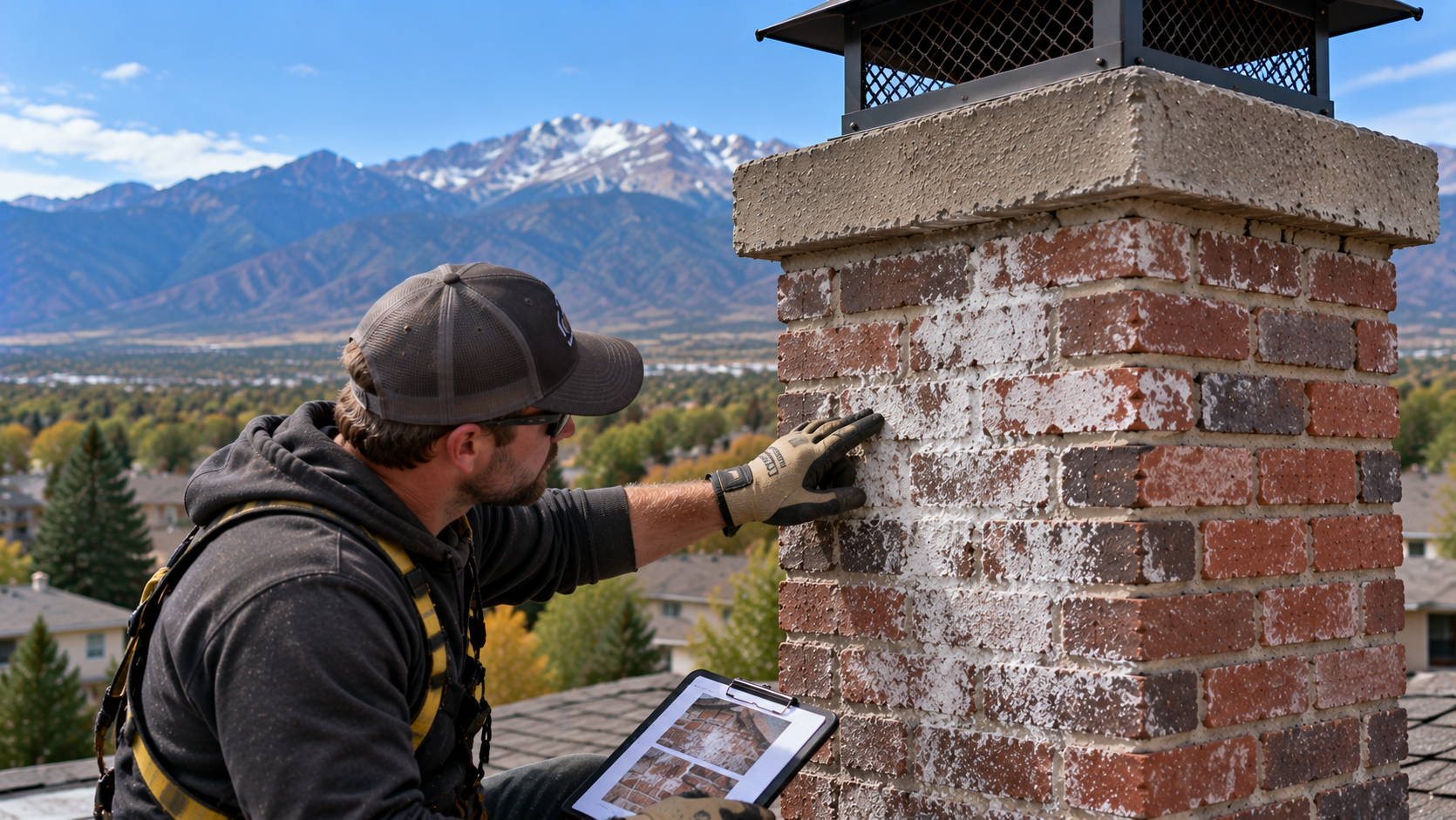
Efflorescence - the white powdery or crusty deposit that forms on masonry when water moves through it - shows up because water is migrating through your chimney wall. As it travels, water dissolves soluble salts, the naturally occurring compounds locked inside brick, mortar, and concrete.
When that water reaches the surface and evaporates, it leaves those salts behind as a white crust or powder. Scrubbing it off cleans the symptom. The salts return because the moisture source is still active.
6,035 ftColorado Springs elevation
Why Colorado Springs Chimneys Show This More After Wet Seasons
Colorado Springs masonry sees distinct efflorescence spikes in spring and early fall.
Here's what most homeowners don't realize about timing. The staining you see in April isn't from April - it's from snowmelt that spent weeks working through the masonry as temperatures cycled above and below freezing. That freeze-thaw action forces water deeper into open mortar joints and hairline crown cracks.
East Colorado Springs and Falcon are particularly active zones for this. In newer masonry construction in those areas, spring snowmelt runoff and irrigation systems keep chimney bases wet longer. The result: moisture has more time to move through the wall, carry more salts to the surface, and deposit a heavier crust.
Altitude matters too. At Colorado Springs elevations, vapor pressure gradients are steeper. Water evaporates faster off exterior surfaces - which means salts deposit more quickly and form a denser crust.
What I Found When the Staining Kept Coming Back
Repeat efflorescence almost always means an undiagnosed moisture entry point upstream.
I walked a Falcon property last spring where the homeowner had scrubbed white staining off the mid-chimney face three times in two years. Every time, it came back heavier.
This is exactly why chimney efflorescence diagnostics in Colorado Springs can't start with the visible stain - that white crust is where the journey ends, not where it begins.
- 1Entry: the crownI started at the crown. Sure enough: a 3/8-inch crack running the full width, partially hidden under moss that had started growing in the opening. Water was entering there during every rain and snow event.
- 2Travel: through the mortar jointsFrom there it traveled down through the mortar joints, picking up soluble salts as it moved. We documented the moisture migration path: crown entry, travel route through two wythe courses, exit point at the south face.
- 3Exit: the white bandThe staining ran in a horizontal band right around the fifth and sixth courses above the roofline - tight, consistent, and always on the south face. Mid-chimney staining concentrated on one face with that kind of banding usually points to a single, stable entry point directly above - not grade-level water, and not liner condensation.
- 4Ruled outThe grade-level drainage was fine. The cap was intact. The liner showed no condensation evidence at that height.
The homeowner had been cleaning the exit point for two years without ever locating the entry. Once the crown failure was identified, the repair path was clear. The staining didn't come back. Diagnostic moisture mapping - systematically identifying every possible water entry point - is the only way to break that cycle of recurrence.
Yes, We Can Inspect Even After You've Cleaned the Surface
Recent cleaning doesn't eliminate diagnostic evidence - the pattern beneath it still speaks.
A lot of homeowners hesitate to call because they scrubbed the chimney last weekend. Don't let that stop you. Efflorescence recurrence - the return of white staining after surface cleaning - leaves evidence that persists even after the deposit is removed.
Staining shadows, mineral tide lines, and salt crystallization patterns in mortar joints remain visible on close inspection. More importantly, the masonry conditions that drove the moisture migration are still present. The crown crack, the open joint, the compromised liner - none of those resolve between cleanings.
Our CSIA-certified technicians are trained to read staining patterns as diagnostic indicators, not just cosmetic issues. That training applies whether the surface is freshly scrubbed or fully encrusted.
Evidence that survives scrubbing
- Staining shadows
- Mineral tide lines
- Salt crystallization patterns in mortar joints
Conditions that don't clean away
- The crown crack
- The open joint
- The compromised liner
Our Diagnostic Standards for Efflorescence Calls
Every efflorescence inspection at Chimney Sweep Colorado Springs maps the full moisture migration path. We don't start with the stain. We start with the system.
- Crown assessment first: Chimney crown failure - cracking or deterioration at the top of the chimney structure - is the most common driver of upper-course efflorescence. Every inspection starts there.
- Cap and flashing check: Both are secondary entry points that compound crown-related moisture.
- Mortar joint evaluation: Open or spalling joints accelerate the moisture migration path through the chimney wall.
- Liner condensation check: Liner condensation - moisture produced when combustion gases cool inside the flue - can migrate outward through liner joints and into surrounding masonry. This is a distinct pattern from exterior water intrusion.
- Grade-level and drainage review: Chimney base staining often points to grade-level water, not moisture from above.
- Staining location mapped to probable source: Upper course staining, mid-chimney banding, and base deposits each suggest different entry mechanisms.
Where the stain sits points to the source
- Upper courses: crown failure
- Mid-chimney banding: an entry point directly above
- Base deposits: grade-level water
Six checkpoints. Every call.
How the Diagnostic Process Works
Inspection Begins at the Top
The inspection starts at the crown. We examine it for cracks, open joints at the crown-flue transition, and surface erosion that creates water channels. Cap seating, flashing laps, and counter-flashing are checked for gaps. We then move down the exterior, mapping the white staining location on each chimney course. Staining location is the key diagnostic variable - upper-course deposits, mid-chimney banding, and base accumulation each suggest a different water entry mechanism. We photograph and document every zone.
Interior and Joint Assessment
Inside, we inspect the liner for condensation evidence - discoloration at joint seams, moisture streaking on liner walls, and back-pressure indicators that suggest draft problems contributing to condensation buildup. Mortar joint condition is assessed on the interior and exterior for open voids that create direct water infiltration paths. At grade level, we evaluate drainage slope away from the chimney base and check for irrigation proximity that keeps soil moisture high against the foundation course.
Post-Diagnostic Documentation
After the full inspection, we compile a moisture migration map: entry points identified, travel paths confirmed, staining locations matched to sources. You receive a clear picture of what's driving the efflorescence on your chimney - whether that's a crown failure, open mortar joints, liner condensation, or grade-level water - before any cleaning or sealing recommendation is made.
Areas We Serve in the Colorado Springs Region
We run chimney efflorescence diagnostics across the full Colorado Springs metro and surrounding communities.
- Colorado Springs
- Briargate
- Falcon
- Black Forest
- Rockrimmon
- Cimarron Hills
- Security-Widefield
- Stratmoor
- Monument
- Palmer Lake
- Fountain
- Manitou Springs
- Woodland Park
- Divide
- Pueblo
- Pueblo West
- Canon City
- Castle Rock
- Parker
Our team serves Colorado Springs neighborhoods including Briargate, Falcon, Black Forest, Rockrimmon, Cimarron Hills, Security-Widefield, and Stratmoor. We also serve Monument, Palmer Lake, Fountain, Manitou Springs, Woodland Park, Divide, Pueblo, Pueblo West, Canon City, Castle Rock, Parker, and the broader Pikes Peak Region. Call to confirm availability in your area.
Ready to Find the Source?
White staining that returns after cleaning has a source - and that source is findable.
Our CSIA-certified team runs full chimney efflorescence diagnostics in Colorado Springs and across the Pikes Peak Region. We map the moisture migration path, identify every water entry point, and give you a documented picture of what's driving the staining - before recommending any repair or sealing work. Call (720) 505-5030 or email info@chimneysweepscoloradosprings.com to schedule your diagnostic inspection.
Frequently Asked Questions
Call and talk to the team directly.
Call (720) 505-5030Pricing for efflorescence diagnostic inspections is not listed here - call (720) 505-5030 for current rates. Diagnostic pricing is separate from any cleaning or repair work. The inspection covers the crown, cap and flashing, mortar joints, liner, grade-level drainage, and staining location - all six checkpoints documented before any recommendation is made.
No - recently cleaned chimneys still show diagnostic evidence. Staining shadows, mineral tide lines, and salt patterns in mortar joints remain after scrubbing. The masonry conditions driving moisture migration - crown cracks, open joints, compromised liner - don't resolve between cleanings. Our CSIA-certified technicians read those residual indicators the same way they read fresh deposits.
Most diagnostic visits take between 60 and 90 minutes on site. That window covers crown-to-grade exterior mapping, interior liner and joint inspection, and grade-level drainage review. A post-inspection moisture migration map is compiled from all findings before any repair or sealing recommendation is given to you.
Sealing over an active moisture source traps water inside the masonry wall. Trapped moisture accelerates freeze-thaw spalling and mortar joint failure - especially given Colorado Springs elevation and hard winters. Surface sealing without diagnostics delays visible staining while internal damage compounds. Finding the entry point first means any sealing or repair actually solves the problem.
Efflorescence diagnostics specifically trace the moisture migration path - not just chimney condition overall. We map where water enters, which direction it travels, and what's driving it. That differs from a standard inspection, which documents component condition without tracing a water pathway. You receive a documented source-to-deposit map, not a general checklist of what's cracked or worn.
Yes - liner condensation produces a distinct staining pattern separable from exterior water intrusion. Condensation evidence shows as discoloration at liner joint seams and moisture streaking on interior liner walls. Crown failure produces upper-course exterior banding. Base deposits suggest grade-level water. Each pattern points to a different source, and our inspection checks all three in the same visit.