
Gas Fireplace Repair in Colorado Springs - Pilot, Burner & Control Faults
Gas Fireplace Diagnosed and Repaired Before Colorado's Next Cold Stretch
Thermopile, thermocouple, gas valve, remote receiver - tested in sequence
- CSIA-certified technicians
- Readings before and after
- No parts swapped on a hunch
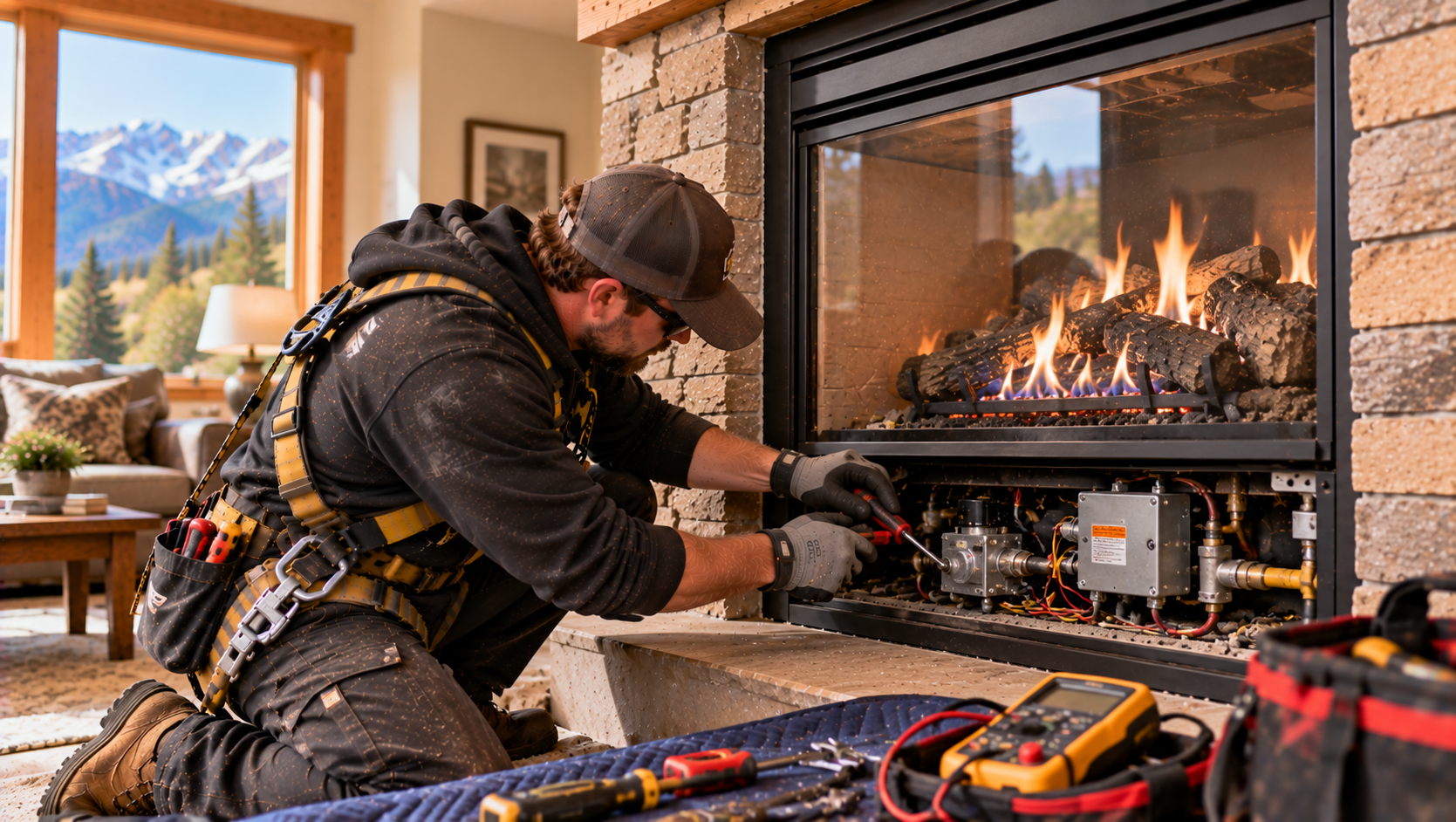
Gas Fireplace Repair Starts With the Right Diagnosis
A gas fireplace repair in Colorado Springs means testing the actual failed part - not guessing at it.
Three calls come in more than any others. The pilot won't stay lit. The remote does nothing. Or the flame comes on, burns for a few minutes, then shuts off on its own. Each symptom looks like a gas fireplace that "just stopped working." But each one points to a different failed component. Knowing which one matters - because replacing the wrong part doesn't fix anything.
At Chimney Sweep Colorado Springs, every gas fireplace repair starts with a component-level diagnosis - the practice of testing each part of the combustion control system individually to find the specific failure point. No assumptions. No parts swapped hoping something changes.
Oct-AprGas fireplace season in Colorado Springs
Colorado Springs Winters Create Real Pressure on Gas Systems
Colorado Springs homes rely on gas fireplaces heavily from October through April - and off-season storage creates specific failure patterns.
Here's what most homeowners don't realize about gas fireplace systems in this climate. A unit that sat unused from April to October doesn't just pick up where it left off. Thermocouples - the heat-sensing safety devices that tell the gas valve to stay open - degrade quietly during the off-season. Pilot orifices, the small openings that meter gas flow to the pilot burner, can develop partial blockages from dust and oxidation during warm months.
We serve gas fireplace repair calls across Colorado Springs, including homes in Fountain, Security-Widefield, Stratmoor, and Cimarron Hills. The elevation here - 6,035 feet at city center - affects combustion air ratios in ways that can stress control components over time. That's a local factor worth knowing before any diagnostic begins.
What the Technician Is Actually Testing
Every gas fireplace repair visit measures millivoltage, solenoid response, and receiver function before any part is touched.
Here's what actually happens on a diagnostic visit - because understanding the process helps homeowners make confident repair decisions.
- 1Thermopile millivoltageA thermopile is the component that generates the small electrical current needed to hold the main gas valve open. When it's healthy, it produces 650 to 750 millivolts. A reading below roughly 325 millivolts under load - what we call degraded thermopile millivoltage - means it can no longer reliably signal the valve. The flame lights, holds briefly, then drops. That's not a gas pressure problem. That's an electrical output problem.
- 2ThermocoupleIf the millivoltage checks out, we move to the thermocouple. This is a simpler safety sensor that monitors pilot flame presence. A failing thermocouple reads low voltage or shows erratic output under load. The pilot won't stay lit - or won't light at all - when this component goes.
- 3Gas valve solenoidNext is the gas valve solenoid - an electromagnetically controlled valve inside the main gas valve assembly. When it fails to open fully, the main burner either won't ignite or produces an uneven, patchy flame pattern. We test solenoid response under operating conditions, not just at rest.
- 4Remote receiverWhen a remote does nothing, the issue is almost always a remote receiver fault. The remote receiver is the electronic module inside the fireplace that picks up the signal from your handheld remote or wall switch. The pilot can be lit, the gas valve can be healthy, and the fireplace still won't respond - because the receiver lost its frequency pairing or its internal components have failed.
- 5IPI ignitionFor units with an intermittent ignition system - an IPI system (electronic ignition that lights the pilot on demand, rather than keeping a standing pilot flame) - we watch for the repeated spark-attempt-then-lockout pattern. IPI faults often look like a fireplace that tries to light, clicks several times, then goes completely dead. That's a distinct failure mode from a standing pilot system and gets a different diagnostic path.
- 6Pilot orificePilot orifices, the small openings that meter gas flow to the pilot burner, can develop partial blockages from dust and oxidation during warm months. We inspect the orifice on every pilot-related call.
Our CSIA certification covers chimney and venting systems, including those serving gas appliances. That training is the foundation for distinguishing thermocouple failure from thermopile degradation from gas valve malfunction - rather than cycling through parts until something works.
Repair vs. Replacement - Here's How That Decision Gets Made
Component-level diagnosis also reveals when repair is the right call - and when it isn't.
Most single-component failures on a gas fireplace under 15 years old are worth repairing. A thermopile replacement or receiver swap is straightforward, cost-effective, and restores full function.
The calculus shifts when multiple components show degraded readings on the same unit. We call this the repair vs. replacement threshold - the point at which the total cost and expected service life of a repaired appliance no longer beats the performance and efficiency of a replacement. We tell homeowners what we found, what each repair involves, and what the realistic life expectancy looks like. Then you decide.
Repair is worth it
- A single-component failure
- A unit under 15 years old
- A thermopile or receiver swap restores full function
Consider replacement
- Multiple components show degraded readings
- Repair cost and service life no longer beat a new unit
Our Standards for Gas Fireplace Repair
Every repair follows a documented diagnostic sequence - no shortcuts, no part swaps on instinct.
- Thermopile millivoltage tested before and after repair to confirm output is within manufacturer spec
- Thermocouple output measured under live pilot flame, not estimated
- Gas valve solenoid tested at operating voltage, not just visually inspected
- Remote receiver signal confirmed with the original remote before the visit is closed
- IPI system lock-out codes checked where applicable
- Pilot orifice inspected for partial blockage on every pilot-related call
- All work documented with pre- and post-repair readings
Three symptoms, three different parts
- Pilot won't stay lit
- Remote does nothing
- Flame comes on, then shuts off
Complete millivoltage documentation on a thermopile. Solenoid response confirmed at operating voltage. This is what a properly closed repair visit looks like in practice.
The Repair Process: Diagnostics Through Post-Service Testing
Symptom-Driven Diagnostics
We start with the symptom you reported. Pilot won't hold, remote unresponsive, flame cycling off - each leads to a different first measurement. We test the thermopile output, thermocouple signal, and gas valve response in sequence. No component is assumed healthy because another one tested low.
Component Replacement
Once the failed component is confirmed, we replace it with the correct part for your specific appliance. Colorado Springs homes have a wide mix of installed fireplace brands and model years. We verify part compatibility before installation, not after.
Post-Service Testing
After the repair, we run the fireplace through a full cycle - pilot, main burner, remote control, and shutoff. Thermopile millivoltage gets re-measured with the repair in place. We don't close the visit until the numbers confirm the fix held.
Areas We Serve
Chimney Sweep Colorado Springs covers the full metro area and the surrounding region.
- Colorado Springs
- Manitou Springs
- Fountain
- Security-Widefield
- Cimarron Hills
- Stratmoor
- Rockrimmon
- Briargate
- Black Forest
- Falcon
- Monument
- Woodland Park
- Pueblo
- Castle Rock
- Parker
We serve gas fireplace repair calls in Colorado Springs, Manitou Springs, Fountain, Security-Widefield, Cimarron Hills, Stratmoor, Rockrimmon, Briargate, Black Forest, Falcon, Monument, Woodland Park, Pueblo, Castle Rock, Parker, and throughout the Pikes Peak Region.
Ready to Get Your Gas Fireplace Working Again?
Call us, and we'll schedule a component-level diagnostic visit for your Colorado Springs home.
Get the right diagnosis first. Call Chimney Sweep Colorado Springs at 720-505-5030 or email info@chimneysweepscoloradosprings.com to schedule your gas fireplace repair visit today.
Frequently Asked Questions
Call and talk to the team directly.
Call (720) 505-5030Call 720-505-5030 for current diagnostic pricing. On the visit, technicians test thermopile millivoltage, thermocouple output, gas valve solenoid response, and remote receiver function in sequence. Each failed component is identified before any parts are ordered. CSIA-certified training guides the diagnostic process, not guesswork.
Most single-component repairs - thermopile, thermocouple, or remote receiver - are completed in one visit. Diagnosis runs first, then part replacement, then a full post-repair test cycle. Thermopile millivoltage is re-measured after the repair to confirm the fix held. Complex failures involving the gas valve or IPI system may require a follow-up visit for parts.
A flame that lights and then cuts out almost always means a degraded thermopile. Thermopile millivoltage below roughly 325 millivolts under load can no longer hold the gas valve open reliably. That's an electrical output problem, not a gas pressure problem. We measure the output directly - the number tells us whether a replacement is needed.
Remote failure and receiver failure look identical from the outside. The remote receiver - an internal electronic module - loses frequency pairing or fails entirely while the remote itself still functions. We test the receiver independently before replacing the remote. Replacing only the remote on a failed receiver fixes nothing.
Component-level diagnosis separates our process from part-swapping. Every repair starts with measured readings - millivoltage numbers, solenoid response under load, receiver signal confirmation. A thermocouple replacement on a unit with a failed thermopile does nothing. Testing each part independently ensures the repair targets the actual failed component, not the most commonly replaced one.
Repair makes sense for most single-component failures on units under 15 years old. The calculation shifts when multiple components show degraded readings on the same appliance. That crossover point - where repair cost and expected service life no longer beat replacement - is called the repair vs. replacement threshold. We provide those findings in writing so you decide with complete information.