Commercial Chimney Repair in Colorado Springs
Commercial Chimney Repair With Documentation That Satisfies Your Board
10+ crew handles extended roof access without subcontracting core work
- CSIA-certified technicians
- Written assessment first
- No subcontracted core work
Commercial Chimney Repair Starts With a Written Condition Assessment
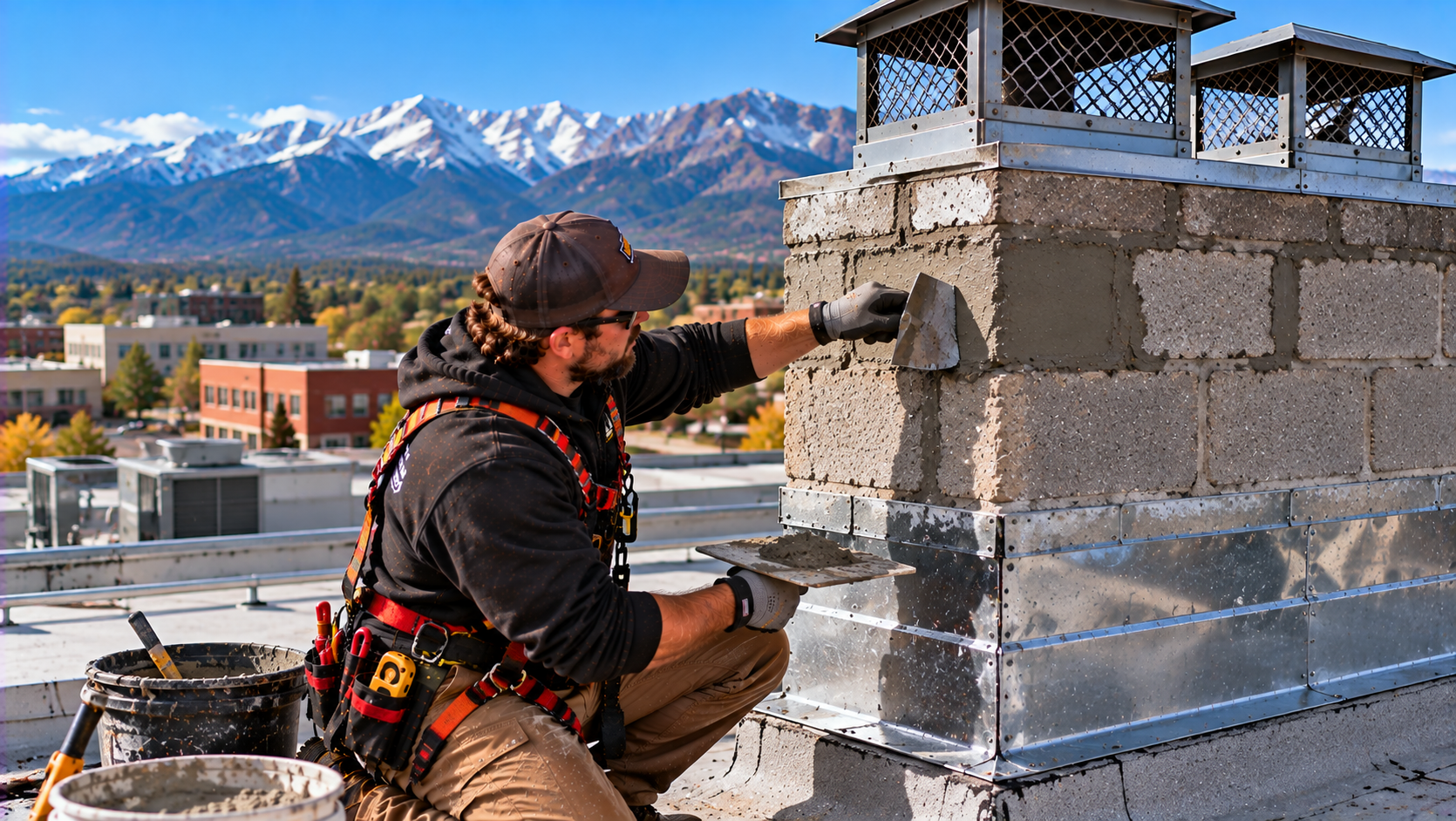
Commercial chimney repair is scoped from a documented assessment - not a verbal guess.
If you manage a hotel, restaurant, school, or multi-unit residential property in Colorado Springs, you already know how this works. Your ownership group needs paper. Your insurer needs findings on file. Your HOA board needs a written scope before a single repair gets approved.
That's exactly where we start.
Chimney Sweep Colorado Springs delivers a written condition assessment before any repair scope is proposed. Every component gets documented - mortar joints, crown condition, flashing integrity, brick face, and liner condition visible from access points. You get a report you can forward, not a phone conversation you have to summarize for a committee.
AprilNights still drop below freezing
Colorado Springs Commercial Properties Face Specific Chimney Conditions
Commercial chimneys along Colorado Springs' I-25 corridor take serious seasonal stress.
Here's what matters about Colorado Springs specifically: the freeze-thaw cycle here runs harder and longer than most of the Front Range. We sit at 6,035 feet elevation. Nights drop below freezing well into April. That repeated freeze-thaw action attacks mortar joints and chimney crowns - and on a commercial chimney stack (a chimney structure serving multiple flues on a commercial or multi-unit property), the crown surface area is larger than a residential crown. More surface area means more exposure. More exposure means faster deterioration.
Properties near the downtown Tejon Street corridor and the Woodmen Road commercial zones tend to run older masonry construction. Many were built before modern crown design standards existed. Our location on E Fountain Blvd puts us within direct reach of those properties, the Briargate multi-unit developments, and the Falcon corridor - without adding drive time that affects your project schedule.
A Multi-Flue Hotel Stack on Cascade Avenue: What the Assessment Found
One written report changed what the ownership group thought they were approving.
I've been on plenty of commercial jobs where the scope grew the moment we got eyes on the upper courses. One that stands out: a multi-flue chimney (a single chimney structure housing more than one flue, common in older commercial buildings) on a Colorado Springs property near Cascade Avenue.
- 1"Some repointing"The facilities director had received a verbal assessment that the stack needed "some repointing." That's all they had going in. When we staged access and reached the top courses, the picture was different.
- 2Crown failure, water belowThe commercial crown failure (cracking and spalling of the chimney crown surface, accelerated by our local freeze-thaw pattern) wasn't limited to surface crazing. It had opened enough for water to migrate into the first few courses below the crown wash.
- 3Efflorescence on two fluesTwo of the four flue liners showed active efflorescence - a white mineral deposit that signals moisture moving through masonry - on the upper sections.
- 4The south-facing sideThe mortar joints on the south-facing side, which takes the most UV and thermal cycling, had receded significantly. That's a repointing job, not a touch-up.
- 5Report first, then approvalWe delivered a written condition report before scoping the repair. The ownership group reviewed it. The insurer reviewed it. Work was approved within the same billing cycle. The repointing at commercial scale - removing deteriorated mortar joints and packing fresh mortar across many more courses than a residential job - was completed in phases that kept the building operational throughout.
None of that would have been approved by the ownership group without documentation. Documentation first. Scope second. Execution third.
Compliance Documentation Is a Standard Part of Every Commercial Job
Every commercial repair includes written findings formatted for compliance submission.
Property managers working with HOA boards, commercial insurers, or institutional ownership groups cannot hand over verbal summaries. Compliance documentation - written records of inspection findings, repair scope, and completed work - is a formal requirement in most commercial contexts.
We build that documentation into every commercial engagement. The condition assessment is formatted for forwarding. The repair scope is itemized. The completed work record reflects what was done, where, and how. It's part of how the job runs.
CSIA certification applies to the repair assessment itself, not just the cleaning visit. That matters when the technician writing your condition report needs to understand the structural and draft system implications of deterioration - not just photograph it.
What you get
- A condition assessment formatted for forwarding
- An itemized repair scope
- A completed work record: what, where, and how
What a board can't use
- A verbal summary
- "Some repointing"
- A phone call you have to retell to a committee
Our Standards for Commercial Chimney Repair
Commercial-scale repair demands different materials, access methods, and documentation practices.
- Written condition assessment completed before any repair scope is proposed
- OSHA roof access requirements (federal workplace safety standards governing fall protection, lift equipment, and staging) followed on every commercial rooftop job
- Repointing at commercial scale completed with mortar matched to existing masonry type - not generic premix
- Multi-flue chimney inspections cover every flue collar, liner section visible from access, and cap/crown condition
- CSIA-certified technician authors the condition report - not a salesperson
- 10+ trained crew members available for multi-day commercial staging without subcontracting core repair work
- Repair record formatted for insurer and ownership group submission
Commercial jobs follow a defined sequence: assess, scope, stage, repair, document.
How We Execute Commercial Chimney Repair
Roof Access & Condition Assessment
We start at the top. Roof access is staged per OSHA roof access requirements before any technician goes up. Once on the roof, we document every component: crown surface condition, flashing integrity at the roof plane, mortar joint recession by elevation, brick face condition, and liner condition visible from the flue opening. Everything is photographed and written into the condition report.
Repair Scoping & Approval
The written condition report goes to you before any scope is proposed. You take it to whoever needs to sign off - board, insurer, ownership group. We don't begin repair work before that approval is documented.
Implementation
Commercial chimney repair implementation depends on the scope findings. Repointing work is completed course by course, starting from the top. Crown repair or commercial crown replacement uses formed concrete matched to the crown geometry. Flashing repair includes counter-flashing and step flashing where the roofline meets the chimney. Multi-flue chimneys get each flue assessed individually - they don't always deteriorate at the same rate.
Post-Repair Documentation
Completed work is documented in the same format as the condition assessment. The final record notes what was repaired, what materials were used, and what inspection findings showed after completion. That document goes to you for your file.
Areas We Serve
We serve commercial properties across the Greater Colorado Springs region.
- Downtown Colorado Springs
- Briargate
- Rockrimmon
- Woodmen Hills
- Falcon
- Pueblo
- Monument
- Castle Rock
- Parker
- Highlands Ranch
- Centennial
- Aurora
Chimney Sweep Colorado Springs handles commercial chimney repair throughout Colorado Springs, including downtown, Briargate, Rockrimmon, Woodmen Hills, and Falcon. We also serve Pueblo, Monument, Castle Rock, Parker, and the broader Pikes Peak Region. Properties in Highlands Ranch, Centennial, and Aurora are within our service radius for commercial engagements.
Get Your Written Condition Assessment Scheduled
Start with documentation - then decide on scope.
If your commercial property has a chimney showing visible deterioration, the right first step is a written assessment. Call Chimney Sweep Colorado Springs at (720) 505-5030 or email info@chimneysweepscoloradosprings.com. Tell us your property type, the number of chimneys, and any known access constraints. We'll confirm scope and get you on the schedule.
Frequently Asked Questions
Call and talk to the team directly.
Call (720) 505-5030Cost depends on stack height, flue count, access equipment required, and scope found during the written condition assessment. Larger commercial stacks with multiple flues and OSHA-compliant staging requirements carry higher project costs than single-flue residential jobs. The written condition assessment documents scope before any pricing is finalized - no verbal estimates are given for commercial work.
Timeline depends entirely on scope findings from the condition assessment. Assessment and documentation typically complete in one visit. Repair phases are then scheduled to keep the building operational throughout - multi-day staging is handled by 10+ trained crew members without subcontracting. Ownership group or insurer approval is confirmed before any repair phase begins, which affects total calendar time.
Verbal estimates cannot be submitted to HOA boards, commercial insurers, or institutional ownership groups. Compliance documentation - written findings, itemized repair scope, and completed work records - is a formal requirement in most commercial contexts. CSIA-certified technicians author every condition report, so structural and draft system implications are captured alongside surface observations.
Commercial repointing covers significantly more mortar joint courses than residential work. Commercial chimney stacks serve multiple flues, run taller, and often show uneven deterioration across elevations - south-facing courses typically recede faster due to UV and thermal cycling. Mortar is matched to existing masonry type, not substituted with generic premix, which prevents differential expansion cracking in Colorado's freeze-thaw conditions.
Yes. Commercial chimney repair at this scale is phased to avoid disrupting tenants, guests, or building operations. Roof access staging follows OSHA fall protection requirements on every job. Phased implementation means repointing and crown work are sequenced - not completed as a single-day shutdown event. The post-repair documentation record is formatted for your file before crews leave the site.
CSIA certification applies directly to commercial repair assessments. The certification covers structural evaluation and draft system analysis - not just cleaning protocol. When a CSIA-certified technician documents mortar joint recession, crown failure, or multi-flue liner condition on a commercial stack, the findings carry the same credentialed weight required by insurers and compliance reviewers.