
Stainless Steel Chimney Chase Cover Installation in Colorado Springs
Custom-Measured Stainless Chase Cover Fitted and Installed on Site
Galvanized starts rusting through at 8-12 years - stainless holds through Colorado's UV
- CSIA-certified technicians
- Type 304 stainless
- Measured to your chase
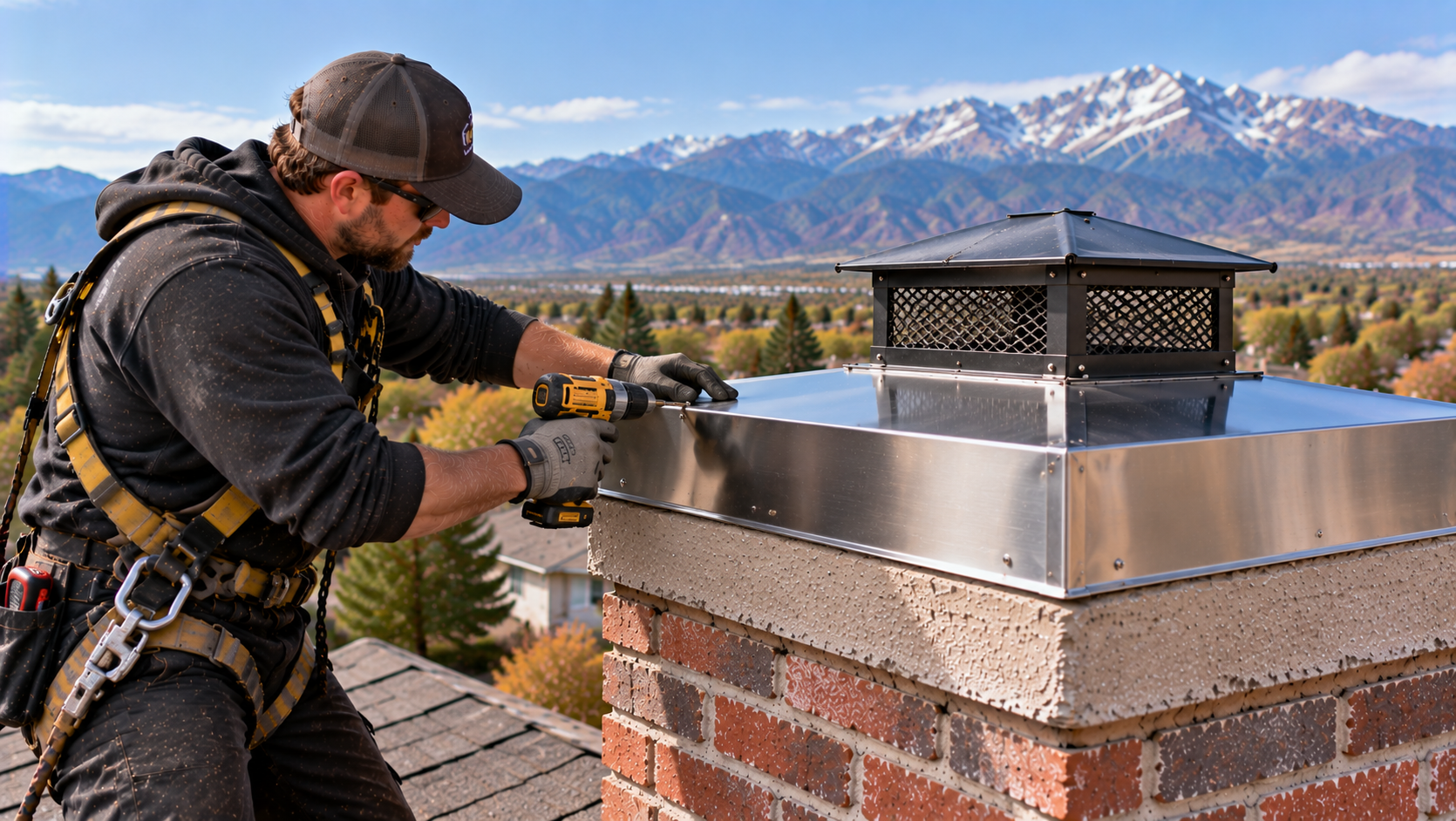
What a Chimney Chase Cover Actually Protects
A chimney chase cover is the last line of defense between your framing and open sky.
Here's what most homeowners don't realize about their prefab fireplace system: there's a wood-framed box around that metal flue pipe. That box - the chimney chase (the framed, enclosed housing that surrounds a factory-built or prefabricated metal flue pipe) - contains a significant air gap. That gap is intentional. It allows heat to dissipate safely from the flue. But that gap also leads straight down to your firebox, your framing, and your insulation.
The chase cover (a flat or sloped metal cap that sits on top of the chimney chase to exclude water, debris, and animals) keeps rain, snow, birds, and leaves out of that cavity. When it works, you never think about it. When it fails, water runs quietly through the framing for months before a smell near the fireplace becomes your first clue.
A properly fitted cover handles the entire top perimeter of the chase. It also has a centered flue collar opening sized to the exact pipe diameter. Every dimension matters. A cover that's close won't cut it - gaps at the edges or collar allow water to work in from the side.
8-12 yrsWhen galvanized rust-through typically begins
Why Colorado Springs Prefab Homes Need Attention Here
Thousands of prefab fireplace systems in Colorado Springs were built with covers that have a limited lifespan.
The suburban buildout along the Powers Corridor and east into Falcon, Black Forest, and Woodmen Hills accelerated through the 1990s and into the 2000s. Developers installed factory-built fireplace systems as standard - they're faster and less expensive than masonry construction.
Those systems came with galvanized steel chase covers. Galvanized steel (a zinc-coated steel material used in older chase covers) relies on a surface coating to resist corrosion. In a mild climate, that coating holds up reasonably well.
Colorado Springs is not a mild climate. We cycle through UV exposure at altitude, hard freezes, wet spring snows, and summer hailstorms - sometimes in the same week. That zinc coating breaks down faster here than manufacturers' published estimates assume. Many galvanized covers in the Briargate and Falcon zip codes are past the eight-to-twelve-year mark where rust-through typically begins.
A home built in 1998 may be sitting on its original cover right now. That's worth knowing.
What I Found on a Woodmen Hills Job Last Spring
Old galvanized covers often fail at the seams first - the flat center holds longer than the edges.
I'm one of the senior technicians here at Chimney Sweep Colorado Springs, and last spring I ran a chimney inspection on a 2001-built home in Woodmen Hills. The homeowner thought they had a soft mortar issue because moisture had shown up near the firebox.
- 1Rusted through at two cornersWhen I got on the roof, the chase cover told the whole story. The galvanized steel cover had oxidized through at two of the four corners. At those corners, water had a clear path into the chase cavity.
- 2The center looked fineThe center section looked almost intact - which is exactly why no one had noticed from the ground.
- 3Staining on the sidingRust staining on the chase siding below confirmed it had been leaking through multiple seasons.
- 4Measured, then madeI photographed the full perimeter, measured the chase top dimensions, and noted the flue collar size. Back at the office, we sourced a Type 304 stainless steel cover - the industry-standard corrosion-resistant alloy used for long-life chase cover fabrication. The cover was cut to the specific dimensions of that chase top. Not a stock approximation.
- 5Fit confirmed before fasteningOn installation day, I confirmed the fit before fastening. The flue collar seated cleanly. The drip edge extended past the siding. No gap at any corner.
That homeowner had a factory-built fireplace system (a prefabricated metal fireplace and flue system installed as a unit, as opposed to a masonry-built chimney) that would have needed framing repair within another season if the original cover had stayed in place. The stainless replacement cost a fraction of what that repair would have run. Three seasons later, that cover looks exactly as it did on install day.
Stainless vs. Galvanized - What the Material Difference Actually Means
Stainless steel doesn't just outlast galvanized - it removes the failure mode entirely.
Galvanized steel depends on a zinc coating. Once that coating wears through, the steel underneath corrodes quickly. At elevation in Colorado Springs, UV intensity accelerates coating breakdown even before moisture enters the picture. A galvanized cover at 6,000 feet degrades faster than the same product installed at sea level.
Type 304 stainless steel is a different category. It's not coated - the corrosion resistance is built into the alloy itself. There's no surface finish to fail. No paint to peel. No zinc to deplete.
Temperature cycling - which Colorado Springs delivers in full - causes metal to expand and contract. Coating-dependent materials crack at the stress points over time. Stainless handles those cycles without developing water intrusion points (the gaps or rust holes in a failing cover through which water enters the chase cavity and contacts framing and insulation).
The practical result: one stainless cover correctly installed and fitted to the chase top dimensions outlasts multiple galvanized replacements. You make the decision once and move on.
Type 304 stainless
- Corrosion resistance built into the alloy
- No surface finish to fail
- Handles temperature cycling
Galvanized steel
- Depends on a zinc coating
- Corrodes quickly once the coating wears through
- Fails at the seam corners first
Our Standards for Chase Cover Fabrication and Installation
Every chase cover we install is measured, confirmed, and fastened - nothing is left to chance. We specify Type 304 stainless steel on every chimney chase cover installation.
- Field measurement of chase top opening dimensions before any cover is sourced or fabricated
- Flue collar sizing confirmed to match the installed pipe diameter - no oversized openings
- Drip edge extension past the chase siding to direct water away from the framing
- On-site fit confirmation before final fastening - gaps at corners or the collar are corrected at this stage
- CSIA-trained inspection of the full chase top condition, including any siding or cap flashing issues
- Documentation of pre- and post-installation condition provided to the homeowner
We carry CSIA certification - the Chimney Safety Institute of America credential that covers factory-built chimney system assessment, including chase and cover condition - because this work requires understanding the full system, not just the cap sitting on top of it.
How the Installation Actually Works
Stage 1 - Chase Top Diagnostics
We access the chase top and document existing conditions. This includes measuring the full perimeter of the chase top opening, noting the flue pipe diameter, and checking for any siding damage or cap flashing issues that need addressing before the cover goes on. If the existing galvanized cover has created water intrusion points at the framing, we document that for the homeowner's records.
Stage 2 - Cover Sourcing and Fabrication
Using the field measurements, we source or fabricate a Type 304 stainless steel chase cover to the specific dimensions of your chase top. Stock covers don't always fit - especially on custom chase widths common in the Falcon and Black Forest developments where builders varied the chase profile from lot to lot. The cover is cut to dimension, the flue collar opening is sized to the pipe, and the drip edge profile is confirmed before we bring it to the job.
Stage 3 - Installation and Fit Confirmation
The cover is set in place and the fit is confirmed before any fastening begins. Corner gaps are checked. The flue collar is seated and inspected. Drip edge clearance from the siding is verified. Only after fit confirmation is the cover fastened and sealed at the flue collar penetration.
Stage 4 - Post-Installation Walk-Through
We photograph the completed installation from multiple angles. We review the documentation with the homeowner - cover dimensions, materials, date of installation. If any adjacent issue was flagged during the diagnostic stage, that's communicated clearly along with recommended next steps.
Areas We Serve in the Colorado Springs Region
We install stainless chimney chase covers across the Greater Colorado Springs area and beyond.
- Colorado Springs
- Briargate
- Falcon
- Woodmen Hills
- Black Forest
- Rockrimmon
- Cimarron Hills
- Security-Widefield
- Monument
- Palmer Lake
- Pueblo
- Pueblo West
- Castle Rock
- Parker
- Woodland Park
- Divide
- Cripple Creek
- Castle Pines
- Highlands Ranch
- Denver metro
Our crews cover Colorado Springs neighborhoods including Briargate, Falcon, Woodmen Hills, Black Forest, Rockrimmon, Cimarron Hills, and Security-Widefield. We also serve Monument, Palmer Lake, Pueblo, Pueblo West, Castle Rock, Parker, and the Pikes Peak communities including Woodland Park, Divide, and Cripple Creek. Castle Pines, Highlands Ranch, and the Denver metro are within our regular service zone.
Ready to Replace That Chase Cover?
A stainless chimney chase cover installed correctly is a one-time repair.
Call Chimney Sweep Colorado Springs at (720) 505-5030 or email info@chimneysweepscoloradosprings.com to schedule your assessment. We'll measure your chase top, confirm the material and fit, and get the installation on the calendar. You can also reach us through the contact form on our website.
Frequently Asked Questions
Call and talk to the team directly.
Call (720) 505-5030Exact cost depends on chase top dimensions, flue collar size, and whether adjacent siding or flashing damage needs addressing before installation. Custom-measured stainless covers carry a higher upfront cost than galvanized stock covers. That difference is recovered quickly - galvanized covers in Colorado Springs typically require replacement within eight to twelve years, while Type 304 stainless does not carry the same failure timeline.
Chase top dimensions vary significantly across prefab fireplace systems. Builders in Falcon, Briargate, and Black Forest developments frequently varied the chase profile from lot to lot. A stock cover that's slightly undersized leaves gaps at the corners - exactly where water enters first. We measure the full perimeter on-site before sourcing or fabricating any cover. Fit is confirmed again before fastening. That two-step check is what prevents the edge-gap failures we find on previously replaced covers that were installed without measurement.
Most chase cover replacements complete in two visits. The first visit covers the diagnostic and measurement - typically under an hour on the roof. The second visit is the installation itself, which runs one to two hours depending on chase access and whether any siding damage needs to be documented. We don't install until the cover is fabricated to the correct dimensions. Rushing that step is how gaps get built in.
Galvanized steel depends on a zinc surface coating to resist corrosion. That coating depletes - it doesn't renew. At Colorado's altitude, UV intensity accelerates the breakdown faster than manufacturers' published estimates assume. Once the coating wears through, the steel underneath corrodes quickly, especially at seam corners. The center section often looks intact while the edges have already failed. Most homeowners don't notice until water staining or a musty smell appears near the firebox - by then, framing moisture is already established.
Yes. CSIA certification covers factory-built chimney system assessment - that includes the chase structure, chase cover condition, and the interface between the flue pipe and the cover's collar opening. Our technicians assess the full chase top condition during every installation, not just the cover itself. That scope matters because a correctly installed cover on a compromised chase top still allows water intrusion through siding gaps or damaged flashing at the perimeter.
Patching a galvanized cover extends the problem rather than solving it. Once rust-through begins at the seam corners, the surrounding metal has already lost its coating integrity. Patching one corner leaves the adjacent sections on the same failure timeline. We document the existing cover condition during the diagnostic visit. If the cover has isolated surface oxidation and the seams remain intact, we note that clearly. When rust-through is confirmed at any corner, replacement is the only repair that addresses the water intrusion point reliably.