
Emergency Furnace Flue Cleaning in Colorado Springs
Furnace Flue Cleared, CO Risk Eliminated & Draft Verified Before Use
Collar through termination cap inspected and cleaned in one emergency visit
- CSIA-certified technicians
- Full exhaust path cleaned
- Gas check before sign-off
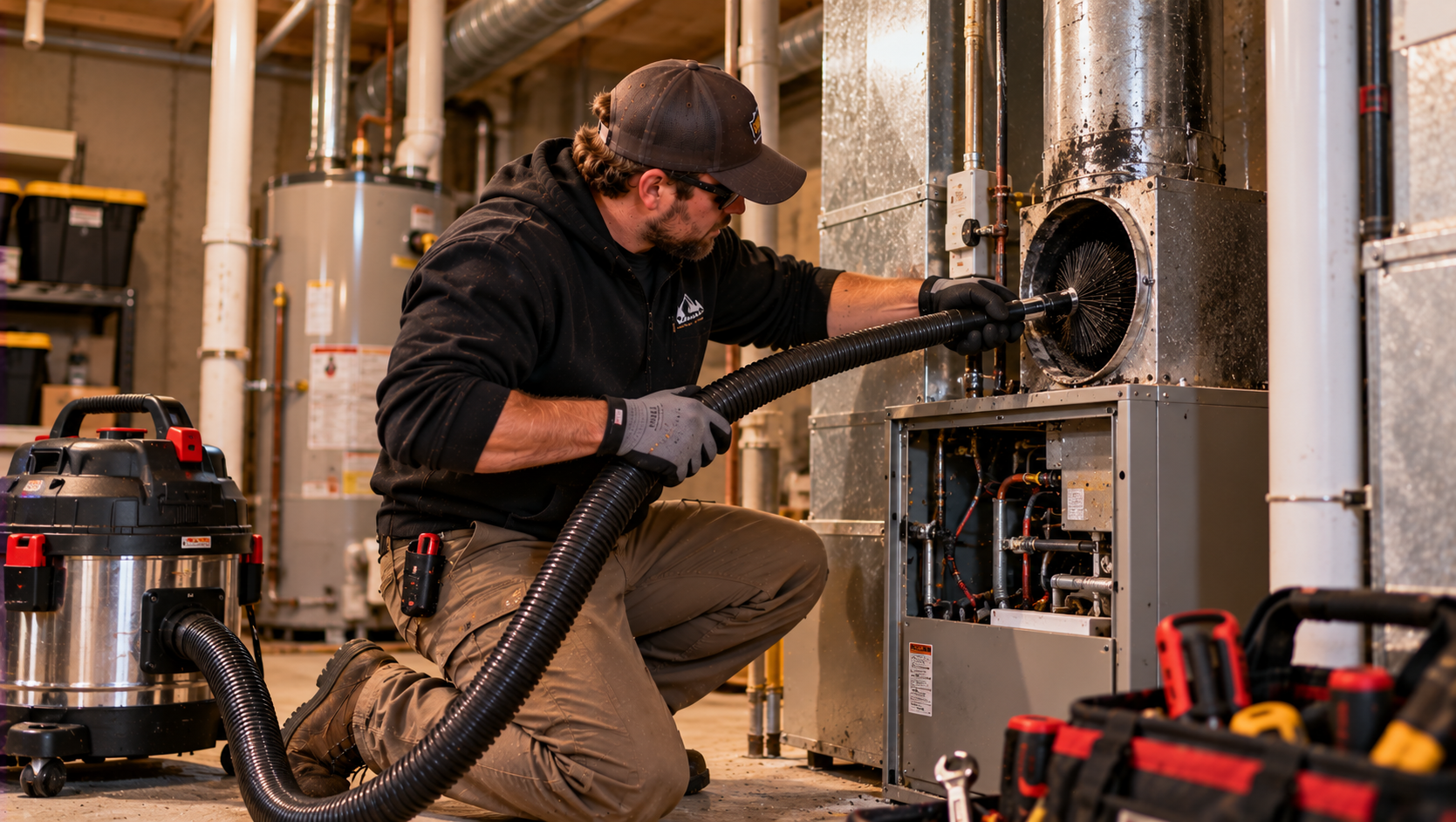
Emergency Furnace Flue Cleaning Covers the Full Exhaust Path
Emergency furnace flue cleaning means one thing: the full exhaust path is cleared and verified safe.
A furnace flue - the exhaust passageway that carries combustion gases from your gas or oil furnace out of the home - is distinct from a fireplace flue. It's narrower, lined differently, and subject to its own code requirements. When that pathway gets blocked, CO (carbon monoxide - a colorless, odorless combustion byproduct) has nowhere to go except back into your living space.
Our CSIA-certified technicians at Chimney Sweep Colorado Springs inspect and clean the entire exhaust system. That means the furnace collar, the connector pipe, the flue body, and the flue termination cap. Then we run a post-clearance combustion gas check before we consider the job finished.
One visit. Full path. Safe to use before we leave.
6,035 ftColorado Springs elevation
Colorado Springs Heating Season Creates a Specific Furnace Flue Blockage Window
Furnace flues in Colorado Springs face a real blockage window every October when heating systems restart.
Here's what most homeowners don't realize about furnace flues in this climate. Heating systems in Colorado Springs typically sit unused from April through September. That's six months for bird nesting material to pack into a flue termination cap, for soot deposits to harden inside the connector pipe, and for a liner section to shift after a dry summer.
When temperatures drop and the furnace kicks back on - often overnight in early October - that's when blockages show up fast.
Our dispatch location at 3595 E Fountain Blvd puts us minutes from Security-Widefield, Stratmoor, and Fountain. When a furnace flue blockage call comes in during heating season, we're not routing from across town. That matters when the furnace is the only heat source and the temperature outside is dropping.
Pikes Peak region elevation also plays a role. At 6,000+ feet, combustion dynamics change. Draft proving - the process of verifying that combustion gases are moving in the correct direction through the flue after cleaning - is more important here than in lower-elevation cities.
What Actually Happens on an Emergency Furnace Flue Call
Every emergency furnace flue call starts the same way - we trace the exhaust path from the source.
Your CO alarm goes off at 11 p.m. in January. You silence it, open a window, and the alarm doesn't trigger again. By morning, the house feels fine. But the furnace ran all night.
- 1Alarm at night, nothing obviousI've been on those calls. A homeowner in the Stratmoor area called us after exactly that scenario - alarm at night, nothing obvious, furnace still running.
- 2A joint behind the access panelWhen we got there, the connector pipe had partially separated at a joint behind the utility room drywall access panel. Not visible from outside. The pipe wasn't completely disconnected, so exhaust was still mostly moving - but backdraft (the condition where exhaust gases reverse direction inside the flue and re-enter the living space) was happening under low-draft conditions, like when interior doors were closed. The CO alarm was accurate. It tripped when backdraft stalled exhaust movement long enough to let combustion gases build in the utility space.
- 3Two inches at the elbowWe pulled the connector pipe section and found heavy soot accumulation at the elbow - roughly two inches of compacted buildup.
- 4Draft proved, furnace cycled twiceCleaned it, re-secured the joint with sheet metal screws and foil tape, then ran a draft proving check at the furnace exhaust outlet. Draft was confirmed clean. We didn't leave until the furnace cycled twice with a clear gas check.
- 5Shared flues in older homesIn older Colorado Springs neighborhoods - particularly homes built in the 1970s and 1980s near Stratmoor and Security-Widefield - furnace flues were sometimes shared with water heater vents in a single masonry chase. If one appliance's flue section gets blocked, it can affect draft for both. We check the full system configuration before we start, not after.
Here's the part that matters: that homeowner's furnace was less than four years old. Blockages don't care about equipment age. They care about what's inside the flue - and what's been accumulating since the last time anyone looked.
CSIA Certification Covers Furnace Flue Systems - Here's What That Means for You
CSIA certification applies to vented heating appliance flues, not just fireplaces.
This is a question we get regularly: "Isn't your certification for chimneys?" Fair question. The answer is no - not exclusively.
CSIA (Chimney Safety Institute of America) certification covers the full scope of vented combustion systems. That includes furnace exhaust pathways, connector pipe systems, and flue termination caps on gas and oil heating equipment. Our technicians are trained under the same standard for furnace flue evaluation as for chimney inspection.
That means when we assess a blocked furnace flue in Colorado Springs, we're using a structured evaluation protocol - not a general cleaning approach. We know what a proper flue liner looks like, what a failed one looks like, and how to tell the difference between a cleaning issue and a liner replacement situation before we start the job.
You get a trained eye on the full system. That's the standard we hold here.
Our furnace flue visit
- Connector pipe joints inspected and cleaned
- Flue body and termination cap cleaned as one system
- Draft direction confirmed before we leave
Standard HVAC maintenance
- Services the furnace unit itself
- Rarely inspects connector joints, flue body, or cap
- Exhaust path not verified as a complete system
Our Standards for Emergency Furnace Flue Cleaning
Every emergency furnace flue cleaning at Chimney Sweep Colorado Springs follows a fixed sequence. Urgent calls get the full protocol - faster, not shorter.
- Pre-clean inspection: Full visual assessment of the connector pipe (the horizontal or angled metal duct connecting the furnace to the vertical flue), flue body, and flue termination cap (the protective cover at the exhaust outlet on the exterior wall or roof)
- Connector pipe check: Joints inspected for separation, corrosion, and soot accumulation - pulled and cleaned when needed
- Flue body cleaning: Rotary brush or chemical treatment depending on buildup type and liner material
- Termination cap inspection: Checked for blockage, screen condition, and proper fit; cleared or replaced on-site
- Draft proving confirmation: Combustion gas check at the furnace exhaust outlet after cleaning is complete
- System return: Furnace cycled and monitored before we sign off
Three passes through the connector pipe section minimum. Not one.
Execution Protocol: How the Service Runs from Arrival to Sign-Off
Arrival Assessment
We assess the full exhaust path before any cleaning begins. When we arrive, the furnace goes off. We don't clean around a running system. First step is a visual walk of the connector pipe from the furnace collar to the flue entry point. We check for visible separation, rust staining below joints (a sign of past condensation leak), and soot marks on surrounding surfaces. We also ask one question right away: has the CO alarm triggered more than once? Multiple triggers suggest an intermittent backdraft condition - not a single blockage event. That changes how we approach the cleaning sequence. At homes in older Colorado Springs neighborhoods, we check whether the furnace shares a flue chase with other appliances. Shared chases require separate clearance checks for each connected system.
Cleaning Sequence
Cleaning starts at the connector pipe and works up to the termination cap. The connector pipe typically holds the heaviest soot concentration - especially at elbows and low points where exhaust slows. We pull accessible sections, clean them externally, and inspect interior surfaces for corrosion or perforation before reinstalling. The flue body gets a rotary brush pass from the top down. For HVAC flue cleaning in Colorado Springs, we size the brush to match the liner diameter - usually 4-inch or 6-inch for residential gas furnace systems. Debris is captured below with a sealed drop cloth at the connector pipe entry point. Flue blockage - any obstruction inside the exhaust passageway, whether debris, nesting material, collapsed liner, or soot buildup - is fully removed before we move to the post-clean phase. If we find a collapsed liner section, we stop and report before proceeding.
Post-Service Testing
Draft proving confirms exhaust is moving correctly before the furnace restarts. After cleaning, we run a combustion gas check at the furnace exhaust outlet. A smoke pencil test at the draft diverter confirms air movement direction. The furnace cycles at least twice under observation. If CO readings at the exhaust outlet are within normal range and draft proving confirms correct flow, we clear the system for use. If readings are elevated, we identify the source before we leave - whether that's a remaining connector pipe issue, a liner problem, or a furnace combustion concern requiring a separate HVAC technician. We document what we found, what we cleaned, and what the post-clean readings showed. You get a written summary before we're off the property.
Areas We Serve in Colorado Springs and Beyond
Chimney Sweep Colorado Springs serves the full Greater Colorado Springs region.
- Colorado Springs
- Fountain
- Security-Widefield
- Stratmoor
- Manitou Springs
- Cimarron Hills
- Rockrimmon
- Briargate
- Black Forest
- Falcon
- Monument
- Pueblo
- Pueblo West
- Canon City
- Woodland Park
- Divide
- Castle Rock
- Parker
- Highlands Ranch
- Littleton
- Centennial
- Aurora
We regularly clean furnace flues in Colorado Springs, Fountain, Security-Widefield, Stratmoor, Manitou Springs, Cimarron Hills, Rockrimmon, Briargate, Black Forest, Falcon, Monument, and Pueblo. We also serve Pueblo West, Canon City, Woodland Park, Divide, Castle Rock, Parker, and the Denver metro including Highlands Ranch, Littleton, Centennial, and Aurora.
Schedule Your Furnace Flue Cleaning Today
Get your furnace exhaust path cleared, verified, and safe to run - this heating season.
A blocked furnace flue requires cleaning before the system runs again. Call Chimney Sweep Colorado Springs at (720) 505-5030 or email info@chimneysweepscoloradosprings.com to schedule your emergency furnace flue cleaning in Colorado Springs. Tell us what triggered the call - CO alarm, furnace shutdown, soot at the registers - and we'll get the right tech dispatched.
Frequently Asked Questions
Call and talk to the team directly.
Call (720) 505-5030Specific pricing is not available without a system assessment. Cost varies based on connector pipe condition, liner type, and whether termination cap replacement is needed. Call (720) 505-5030 for an accurate estimate based on your system configuration.
Yes - a single CO alarm trigger is enough reason to inspect and clean the furnace flue before the system runs again. Intermittent backdraft can cause CO to accumulate below the alarm's reset threshold. The alarm was almost certainly accurate. Our CSIA-certified technicians check for partial blockages and connector pipe separation that don't trigger alarms consistently.
Most visits take two to three hours from arrival to completed draft verification. That includes the pre-clean inspection, connector pipe removal and cleaning, flue body brush pass, termination cap check, and post-clean combustion gas check. The furnace cycles at least twice under observation before we clear it for use.
CSIA certification covers vented heating appliance flue systems - not just fireplaces. Standard HVAC technicians service the furnace unit itself but rarely inspect the connector pipe joints, flue body, or termination cap as a complete system. We clean and verify the full exhaust path and confirm draft direction before leaving.
No - accessible connector pipe sections are removed for cleaning. Elbows and low points hold the heaviest soot buildup. Brushing through an installed pipe misses compacted deposits at joints. Removal also lets us inspect for perforation, rust, and separation that cause backdraft even when the pipe appears intact from outside.
Written findings are provided before the technician leaves the property. The summary covers what was found in the connector pipe and flue, what was cleaned or replaced, and the post-clean combustion gas check results. That documentation is useful for insurance records and confirms the system was verified safe before restart.