
Gas Fireplace Inspection in Colorado Springs
Burner, Pilot, Gas Valve, Venting & CO Output Checked by CSIA Tech
Gas fireplace inspection is different from a chimney sweep - scope explained upfront
- CSIA-certified technicians
- CO measured, not estimated
- Written report every time
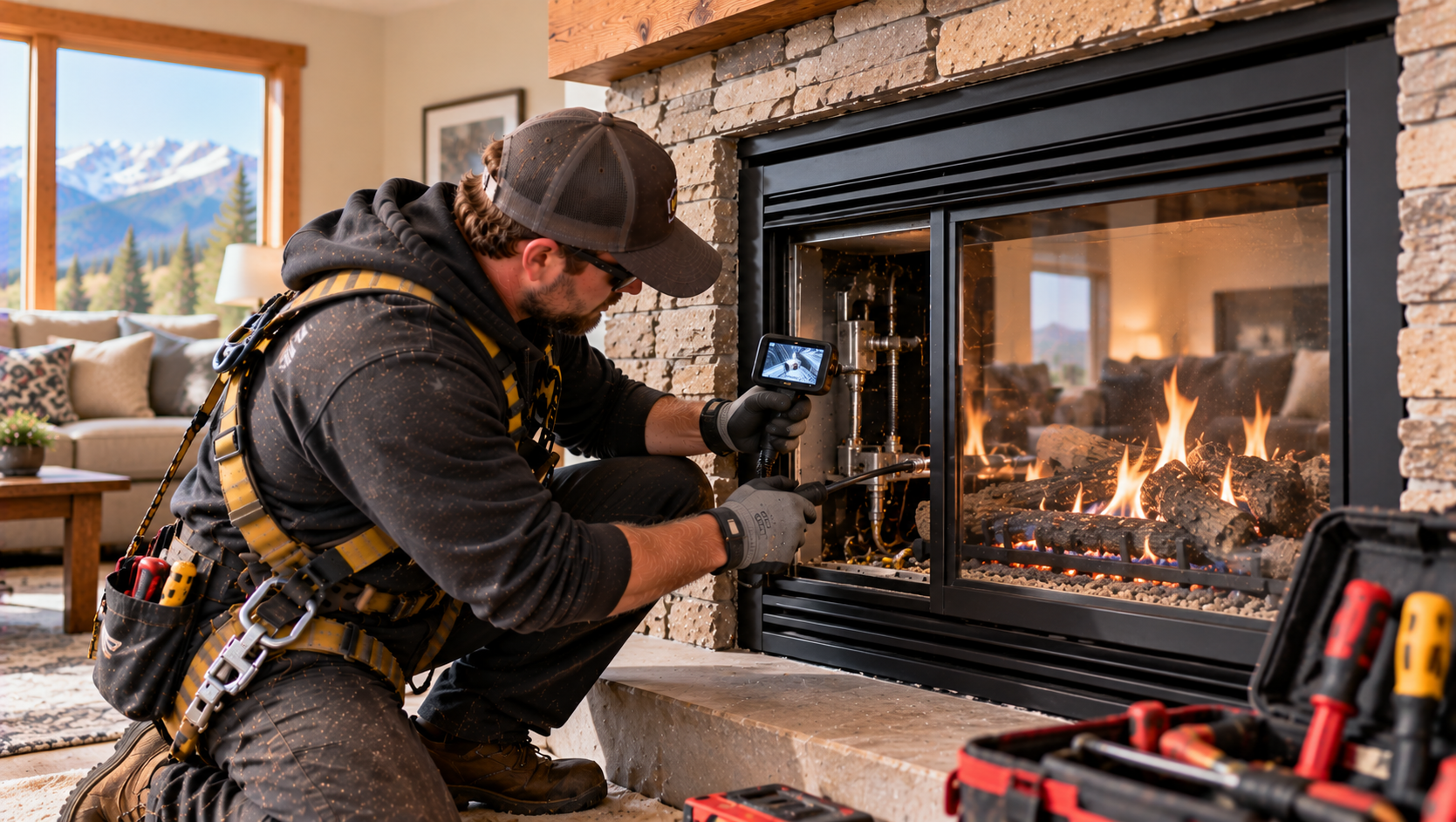
What a Gas Fireplace Inspection Actually Covers
A gas fireplace inspection is a combustion system check - not a sweep, not a cleaning.
It has nothing to do with soot or creosote. The focus is on combustion components that degrade over time: the pilot assembly, the thermocouple or thermopile, the gas valve, the burner pattern, and the venting path. Then comes a carbon monoxide output check.
Carbon monoxide output is the concentration of CO produced at the unit during active combustion. That number tells you whether the fireplace is burning cleanly and whether the venting path is working. Both matter.
A gas fireplace inspection from Chimney Sweep Colorado Springs covers every one of those points. Our CSIA-certified technicians - CSIA stands for Chimney Safety Institute of America, the nationally recognized credentialing body for chimney and venting professionals - check the full system. Not just what's visible through the glass.
15-20 yrsAge of many mid-2000s direct-vent systems
Why Colorado Springs Gas Fireplaces Benefit From an Annual Check
Colorado Springs winters put real demands on gas fireplaces - and the off-season creates its own wear.
Here's what most homeowners don't realize about gas fireplaces in this region. After sitting unused through a dry, high-altitude summer, components cool, contract, and collect particulates. The Pikes Peak region's altitude - sitting above 6,000 feet in many neighborhoods - affects combustion differently than sea-level installations. At altitude, slightly less oxygen is available per cubic foot of air. A gas valve or burner assembly that was calibrated correctly at installation can drift over time. That drift changes flame pattern and combustion efficiency.
Homes in Rockrimmon and Briargate often have direct-vent systems installed during the mid-2000s building boom. Those units are now 15 to 20 years old. Direct-vent venting integrity - the condition of the co-axial exhaust and intake pipe system - becomes a real inspection point at that age, not a formality.
Monument and Palmer Lake homeowners see colder overnight temperatures than the city core. Gas fireplaces there often run harder and longer. That means more thermal cycling on every component. Annual inspection timing matters.
What the Technician Finds During a Gas Fireplace Inspection
Every gas fireplace tells a story - the inspection sequence is how you read it.
One fall, I was scheduled for an annual gas fireplace inspection at a home off Woodmen Road in Colorado Springs. The homeowner called because the remote wasn't responding reliably - sometimes the fireplace lit on the first command, sometimes it took four or five tries, and once it didn't light at all.
- 1A remote that worked sometimesSometimes the fireplace lit on the first command, sometimes it took four or five tries, and once it didn't light at all. The homeowner thought they had a remote problem.
- 2Thermopile at 180 millivoltsMy first check was the thermopile. A thermopile is a heat-to-electricity generator used in millivolt gas fireplace systems. It powers the gas valve and remote receiver without external power. When a thermopile degrades, you get exactly the symptom this homeowner described - intermittent ignition, delayed response, or no response at all. I measured the millivolt output under load. It read 180 millivolts. Minimum acceptable output for most gas valve systems is around 325 millivolts. That unit was running at barely half the power it needed.
- 3An oxidized thermocoupleWhile I had the fireplace open, I checked the thermocouple - the safety device that detects pilot flame presence and keeps the gas valve open. A failing thermocouple causes the pilot to extinguish without warning. This one had visible oxidation at the sensing tip. It would have failed within a season.
- 4A two-inch gap in the intakeThen I checked direct-vent venting integrity. The outer intake pipe had separated about two inches at a coupling behind the firebox. That gap was pulling untempered air from inside the wall cavity into the combustion air supply. At altitude, that matters.
The homeowner thought they had a remote problem. What they had was three overlapping component issues. One inspection. Three findings. All documented.
Who Is Qualified to Inspect a Gas Fireplace?
CSIA-certified technicians cover the venting system as part of their defined scope.
This is a fair question and one worth answering directly. HVAC technicians handle gas lines, furnaces, and mechanical systems. Gas fireplace inspection also includes the venting path - direct-vent venting integrity, vent termination condition, and combustion output measurement at the appliance.
CSIA certification covers chimney and venting systems, including the venting that serves gas appliances. That scope includes the co-axial venting assembly behind the firebox and CO output measurement at the unit.
At Chimney Sweep Colorado Springs, our technicians hold CSIA certification. When we inspect a gas fireplace, the venting path is part of the job - not an optional add-on.
CSIA-certified inspection
- Direct-vent venting integrity
- Vent termination condition
- CO output measured at the appliance
Typical HVAC visit
- Gas lines
- Furnaces and mechanical systems
Our Standards for Every Gas Fireplace Inspection
Every inspection follows a fixed sequence - no component gets skipped.
- Pilot assembly assessment: Pilot burner, thermocouple, and igniter evaluated together as a system. The pilot assembly is the ignition foundation - we don't check parts in isolation.
- Thermocouple and thermopile testing: Output measured under load, not just at rest. Degraded readings are documented with actual millivolt numbers.
- Gas valve function check: Verified for correct open/close response and remote or thermostat command reliability.
- Burner pattern inspection: Flame appearance, distribution, and color assessed for combustion efficiency indicators.
- Direct-vent venting integrity check: Co-axial pipe condition, coupling integrity, and termination cap clearance verified.
- Carbon monoxide output measurement: CO concentration measured at the appliance during operation - not estimated.
- Full written documentation: Every finding recorded. Homeowner receives a written report.
You know what's working. You know what needs attention.
How We Run a Gas Fireplace Inspection From Start to Finish
Starting With Pilot and Ignition
The technician starts with a visual walk-around - firebox surround, glass panel condition, external venting termination cap. Then the firebox is opened and the pilot assembly is assessed first. Thermocouple and thermopile output are measured under active load conditions. Gas valve response is tested with the original remote or thermostat, not just manually.
Moving Through the Venting Path
With combustion components checked, the technician moves to the venting path. For direct-vent systems, the co-axial pipe connections behind the firebox are inspected for separation, gaps, or material degradation. Vent termination outside the home is checked for obstruction and proper clearance from grade, windows, and adjacent surfaces. Corroded or damaged components are documented.
Confirming Output Before We Leave
The fireplace runs for a sustained period - not just a quick ignition test. Carbon monoxide output is measured at the unit during active operation. Flame pattern is observed across the full burner. Remote or thermostat response is confirmed across multiple command cycles. The technician walks the homeowner through all findings before leaving. Nothing is left unexplained.
Areas We Serve in the Colorado Springs Region
We schedule gas fireplace inspections across the greater Colorado Springs area.
- Rockrimmon
- Briargate
- Monument
- Palmer Lake
- Black Forest
- Woodmen Hills
- Cimarron Hills
- Manitou Springs
- Security-Widefield
- Falcon
- Peyton
- Fountain
- Stratmoor
- Pueblo
- Castle Rock
- Parker
We serve Rockrimmon, Briargate, Monument, Palmer Lake, Black Forest, Woodmen Hills, Cimarron Hills, Manitou Springs, Security-Widefield, Falcon, Peyton, Fountain, Stratmoor, and all surrounding Colorado Springs communities. We also schedule inspections in Pueblo, Castle Rock, Parker, and the Pikes Peak Region.
Schedule Your Gas Fireplace Inspection
A complete gas fireplace inspection gives you a documented answer - not a guess.
Every inspection from Chimney Sweep Colorado Springs ends with a written report covering every system checked. You know what's working. You know what needs attention. Call us at 720-505-5030 or email info@chimneysweepscoloradosprings.com to schedule your gas fireplace inspection in Colorado Springs.
Frequently Asked Questions
Call and talk to the team directly.
Call (720) 505-5030Specific pricing is available by calling 720-505-5030. Our inspection covers the full combustion system: pilot assembly, thermocouple, thermopile, gas valve, venting path, and live CO output measurement. Every finding is documented in a written report before we leave.
Most inspections are completed in 60 to 90 minutes. That includes pilot and ignition testing, millivolt output measurement under load, venting integrity checks behind the firebox, and a sustained burn for CO output measurement. The technician walks you through every finding before leaving. Nothing is summarized at the door.
Yes, if the venting path wasn't included in the scope. HVAC technicians typically cover gas lines and mechanical function. CSIA-certified technicians specifically evaluate direct-vent venting integrity, co-axial pipe condition, and combustion output at the appliance. Those are distinct inspection points. Missing them leaves the most serious safety findings unchecked.
Carbon monoxide output is the concentration of CO the unit produces during active combustion. Elevated CO readings indicate combustion inefficiency or a venting failure - gases aren't fully exhausting. We measure this at the appliance during a sustained burn, not by visual estimate. A gas fireplace can look and smell normal while producing dangerous CO levels.
Gas insert inspection follows the same combustion-system sequence: pilot assembly, thermocouple or thermopile output, gas valve response, burner pattern, and venting integrity. Inserts use a different venting configuration - typically a liner running up the existing flue - so the venting check addresses liner termination and connection points specific to the insert installation.
A pilot that repeatedly extinguishes usually points to thermocouple failure, but that diagnosis requires measurement - not assumption. Thermocouple degradation, thermopile output drop, and gas valve malfunction can all produce the same symptom. We test millivolt output under load before recommending any replacement. Replacing one part without testing the system often leaves the root cause unfound.