
Damper Repair and Replacement in Colorado Springs
Damper Inspected, Diagnosed & Fixed in a Single Service Visit
Hands-on assessment of throat plate, hinge, pivot rod, and linkage together
- CSIA-certified technicians
- No parts ordered on a guess
- Most repairs in one visit
What Chimney Damper Repair Actually Covers
A chimney damper repair means fixing the specific part that failed - not replacing the whole assembly by default.
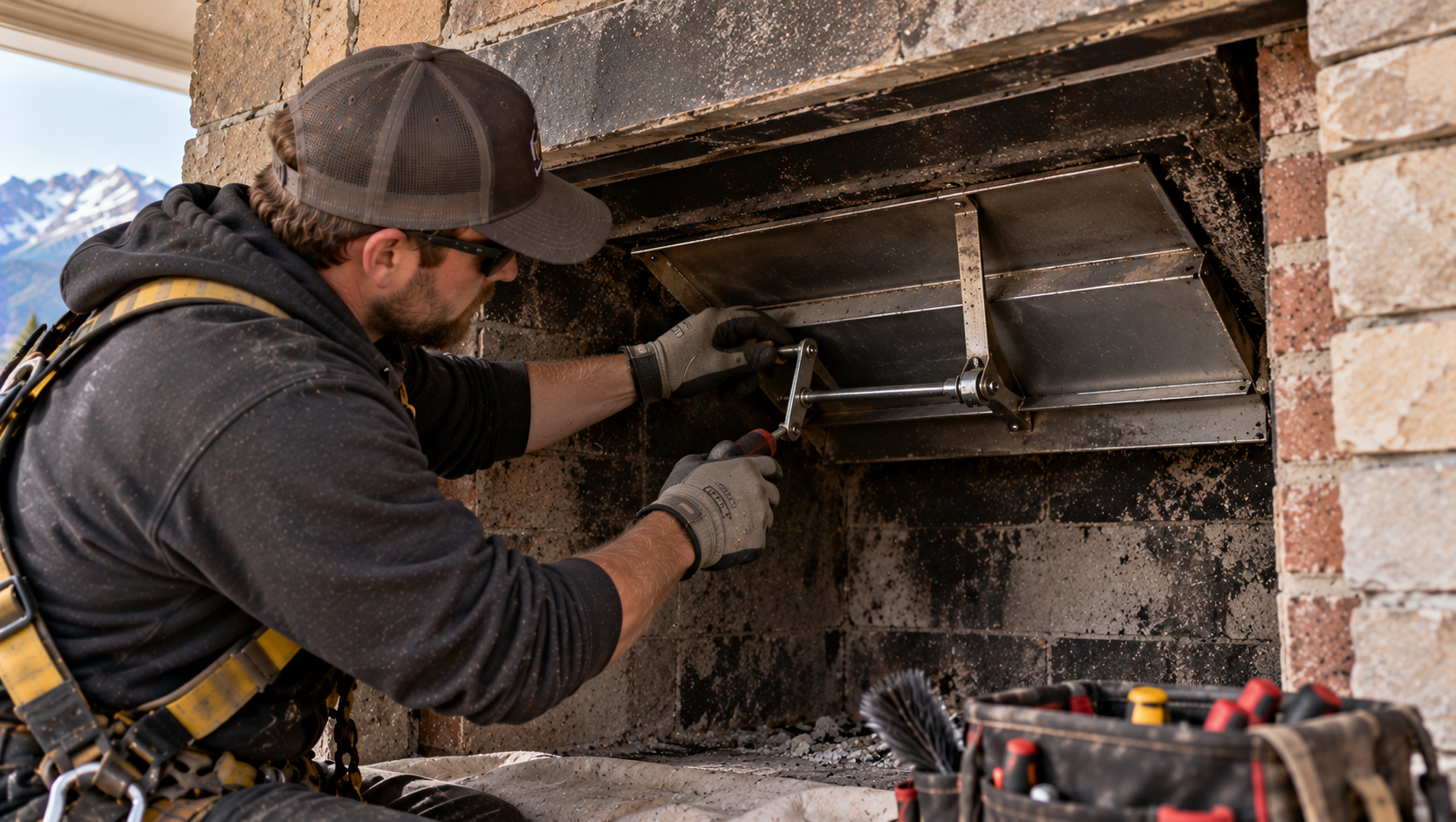
The throat damper - a metal plate mounted just above the firebox that opens and closes to control airflow between the firebox and the flue - is a simple mechanism with a few moving parts. Simple doesn't mean it lasts forever. The damper plate, the pivot rod it rotates on, the hinge, the handle linkage, and the cast iron damper frame all take heat, moisture, and corrosion over years of use.
CSIA-certified technicians at Chimney Sweep Colorado Springs assess every component before anything gets ordered. That distinction matters. A damper plate that looks warped might actually be riding a bent pivot rod. Replacing the plate won't fix the seal. We find the actual failure point first.
This service covers mechanical repair, full replacement when the frame or plate is beyond service, and fireplace insert compatibility adjustments when a new insert makes the existing throat damper obsolete.
6,035 ftColorado Springs elevation
Colorado Springs Dampers Take More Punishment Than Most
The Pikes Peak region's wind patterns create pressure shifts that accelerate damper wear.
Here's what most homeowners in Colorado Springs don't realize about their dampers. The issue often isn't one dramatic failure. It's slow mechanical drift caused by repeated thermal expansion and contraction across hundreds of fire cycles. Metal expands when the firebox heats up. It contracts when it cools. Over time, the damper plate bows slightly. The pivot rod - the metal rod the damper plate rotates on - loses its tight fit in the socket.
Wind behavior around Pikes Peak makes this worse. When strong downslope winds hit the Front Range, outside air pressure at the chimney top can exceed indoor pressure significantly. That creates draft reversal - a condition where outside air pushes down into the flue and enters the living space. A damper sealing adequately in calm conditions will allow cold air through under that pressure load.
Homes in Stratmoor, Fountain, and Security-Widefield sit in areas where that wind exposure is consistent from late fall through early spring. Our crew dispatches from 3595 E Fountain Blvd and knows these neighborhoods well.
A January Service Call That Started With Cold Feet
Cold air at floor level near the firebox almost always traces back to a damper that's no longer sealing.
I pulled up to a home in Stratmoor on a January morning when the temperature hadn't broken 18 degrees overnight. The homeowner said the same thing I hear a lot: "The fireplace just gets drafty sometimes. We thought that was normal." She'd been putting a rolled towel against the firebox opening on cold nights.
I got a light into the throat and saw the problem immediately. The damper plate was sitting at about a 10-degree angle instead of flat against the frame. That's enough of a gap to let cold air slide right through. Before I called it a bent plate, I checked the pivot rod. Sure enough, the rod had a visible corrosion pit at the socket end. The plate wasn't warped - it was riding crooked because the pivot had seized at an off-center angle.
Here's how I think about these calls. The symptom tells you where to look. The mechanism tells you what actually happened.
- 1Cold air near firebox in winterDamper plate not seating flat; pivot rod worn or seized.
- 2Smoke enters room when fire startsPlate stuck in closed or partial position.
- 3Damper handle moves but nothing changesLinkage rod disconnected or bent.
- 4Visible rust streaks below firebox openingCast iron damper frame corroding at edges.
- 5Stale or musty odor from fireplace in summerPlate not closing fully; outdoor air entering freely.
- 6Grinding or resistance when operating damperDebris on smoke shelf jamming the plate travel.
The smoke shelf - the horizontal ledge behind the throat damper that catches falling debris and rain - gets overlooked in most damper calls. A shelf loaded with debris can physically block the damper plate from closing. That's a cleaning issue, not a parts issue. Knowing the difference keeps the repair bill accurate.
That Stratmoor job ended with a new pivot rod and a light cleaning of the smoke shelf. Plate sealed flat. Draft corrected. No rolled towel needed anymore.
Repair or Replace - Here's the Plain Answer
The damper assembly can usually be repaired if the cast iron frame is intact and undamaged.
The cast iron damper frame - the fixed frame that holds the throat damper plate - is the load-bearing structure of the entire assembly. If that frame has cracked, warped significantly, or lost its mortar seal against the firebox masonry, plate or pivot rod replacement won't produce a reliable seal. That's a full replacement call.
Fireplace insert compatibility requires that the existing throat damper either be modified to accept the insert collar or removed entirely. A damper left in place behind a new insert creates airflow restrictions.
If draft reversal is occurring even with the damper in good mechanical condition, a top-sealing damper may serve the home better than a throat damper repair. That's a separate service, and we'll walk you through the difference on-site.
We document the finding and the reasoning. You know exactly what failed and why before any work starts.
Repair is the right path
- The frame is solid
- The failure is in the plate, pivot rod, or handle linkage
Replacement or removal
- The frame is cracked or warped
- The fireplace is being fitted with an insert
Our Damper Service Standards
Every damper visit follows the same hands-on protocol - no shortcuts based on assumed failure modes.
- Full mechanical inspection of throat plate, pivot rod, hinge, handle linkage, and cast iron damper frame before any part recommendation
- Smoke shelf condition assessed as part of every visit - debris blocking plate travel is cleared before diagnosis is finalized
- Draft reversal testing performed if the homeowner reports cold air infiltration, regardless of damper appearance
- Fireplace insert compatibility reviewed whenever the customer mentions a future or recent insert installation
- CSIA-certified technicians conduct all diagnostic and repair work
- Repair findings documented in plain language - symptom, root cause, and corrective action
- No parts ordered until the failure mode is confirmed hands-on
Every repair starts the same way - light in the throat, hands on the assembly.
How Damper Repair Works: Start to Finish
Diagnostic Assessment of Throat Assembly
The technician examines the damper plate for warping, the pivot rod for corrosion or misalignment, the hinge points for wear, and the handle linkage for disconnection or bending. The smoke shelf is inspected for debris accumulation restricting plate travel. Draft behavior is evaluated if cold air infiltration is reported. The cast iron damper frame is checked for cracks at mortar joints and at the plate seat. All findings are explained to the homeowner before any next step.
Repair or Replacement Implementation
Parts are matched to the actual failure - not selected from a default list. Pivot rod replacement, plate reseating, and linkage reconnection are performed on-site in most cases. Full damper replacement involves removing the original throat assembly and installing a correctly sized replacement unit matched to the firebox opening dimensions. Mortar resetting of the frame seat is completed as part of full replacement. If a top-sealing damper is selected during the visit as the better fit, the throat opening is prepared accordingly.
Post-Service Testing and Confirmation
The damper gets operated through its full range before the job is closed out. The plate is cycled open and closed to confirm smooth travel with no binding. Draft behavior is checked - the technician confirms the flue drafts correctly with the damper open and that cold air infiltration is eliminated with the damper closed. Any adjustment to handle tension or linkage fit is made during this phase. The homeowner operates the damper themselves before the technician leaves so they understand the feel of a properly working assembly.
Colorado Springs Areas We Serve
Chimney Sweep Colorado Springs reaches the full region - city neighborhoods and surrounding communities alike.
- Colorado Springs
- Stratmoor
- Security-Widefield
- Fountain
- Cimarron Hills
- Rockrimmon
- Briargate
- Falcon
- Black Forest
- Manitou Springs
- Monument
- Woodmen Hills
- Pueblo
- Pueblo West
- Canon City
- Woodland Park
- Divide
- Castle Rock
- Parker
Our crew serves Colorado Springs, Stratmoor, Security-Widefield, Fountain, Cimarron Hills, Rockrimmon, Briargate, Falcon, Black Forest, Manitou Springs, Monument, Woodmen Hills, Pueblo, Pueblo West, Canon City, Woodland Park, Divide, Castle Rock, Parker, and beyond. If you're in the Pikes Peak region, we likely serve your neighborhood.
Schedule Your Damper Diagnosis Today
A well-sealed damper improves comfort, air quality, and heating efficiency in your Colorado Springs home.
Chimney Sweep Colorado Springs handles damper repair and replacement with a hands-on diagnostic first - every time. Call us at (720) 505-5030 or email info@chimneysweepscoloradosprings.com to schedule your visit. If you prefer to book online, use the contact form on our website. Tell us what you're noticing - draft, smell, a handle that won't move - and we'll take it from there.
Frequently Asked Questions
Call and talk to the team directly.
Call (720) 505-5030Repair costs less than replacement in most cases. If the failure is a worn pivot rod or disconnected linkage, parts and labor run significantly less than removing and reinstalling a full throat assembly. A cracked or warped cast iron damper frame requires full replacement - that costs more. CSIA-certified technicians confirm the actual failure mode before quoting either option, so you're not paying replacement prices for a repair job.
Yes - diagnosis and repair are completed in a single visit for most mechanical failures. The technician inspects the throat plate, pivot rod, hinge, and handle linkage on arrival. If the needed parts are standard, repair follows the same day. Full frame replacement may require a return visit depending on parts availability. Either way, findings are explained to you before any work begins.
Free handle movement with poor draft usually means a disconnected or bent linkage rod. The handle turns, but nothing moves the plate. That's a mechanical repair, not a replacement. Draft reversal from Pikes Peak wind pressure can also mimic a damper problem even when the assembly is intact. The technician tests both conditions before drawing a conclusion.
Every visit starts with hands-on inspection of all five components - plate, pivot rod, hinge, linkage, and cast iron frame - before any part is ordered. Most companies replace the plate by default. Replacing the plate when the pivot rod is the actual failure point produces the same poor seal. We find the specific failure first, then match the repair to it.
A damper stuck open is a comfort issue, not an immediate safety hazard. A damper stuck closed is a serious problem - lighting a fire with a closed damper fills the room with smoke and carbon monoxide. If your damper won't open, stop using the fireplace until it's repaired. CSIA-certified technicians can confirm the damper's actual position during the diagnostic visit.
Damper repair is the right call when the cast iron frame is intact and the failure is mechanical. A top-sealing damper fits better when the throat assembly is beyond repair or when draft reversal from wind pressure is the main problem. The technician evaluates both options on-site and explains the difference in plain language before you decide.