
Gas Log Installation in Colorado Springs - Vented & Vent-Free Options
Convert Your Wood-Burning Fireplace to Gas Logs the Right Way
Knowing which configuration your firebox supports saves costly rework later
- CSIA-certified technicians
- Firebox assessed first
- Leak-tested, full cycle run
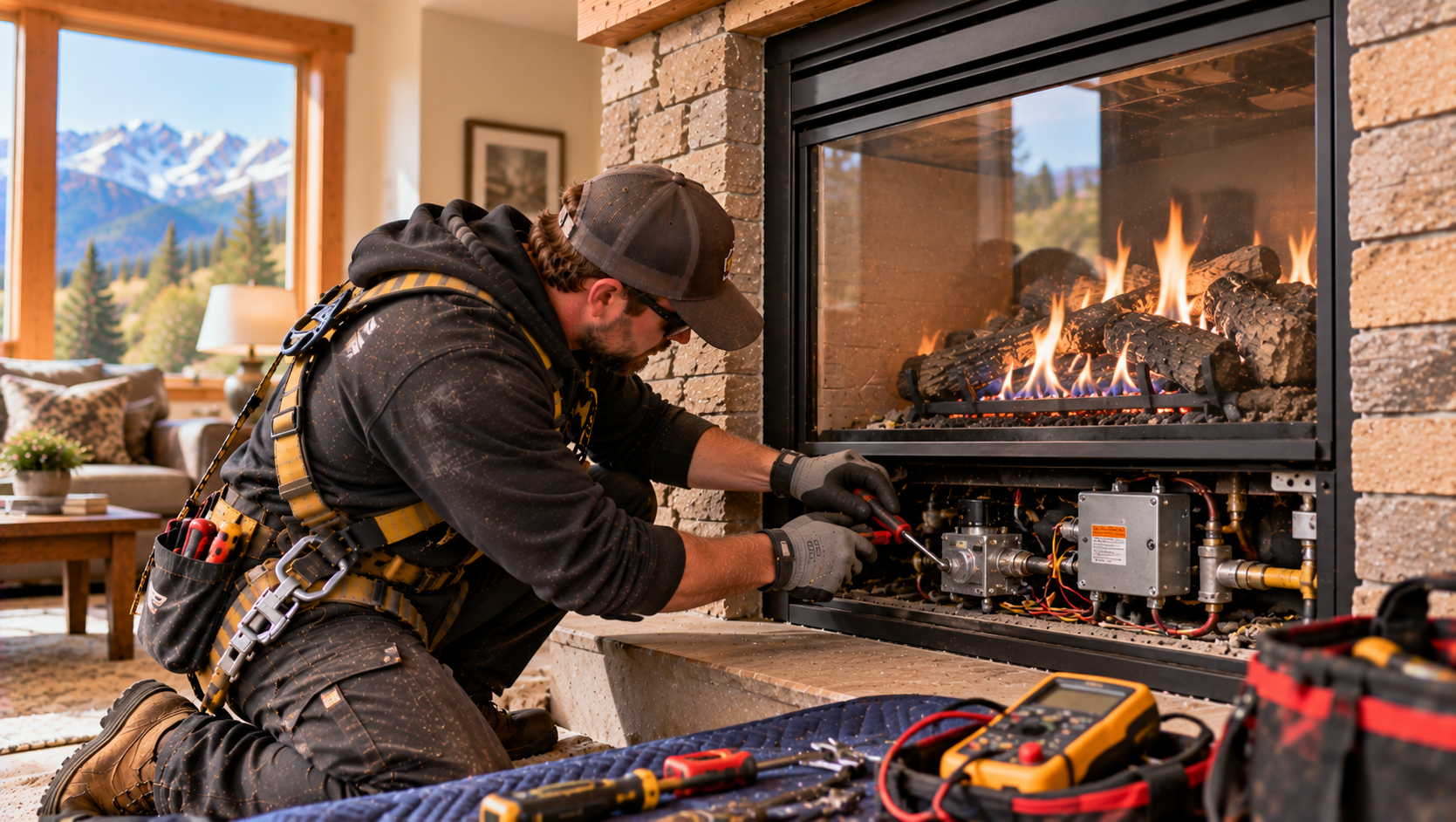
Vented or Vent-Free - Here's What Your Firebox Actually Determines
Your firebox geometry, not your preference, decides which gas log set fits safely.
You want gas logs. That part is clear. What isn't clear yet is whether your existing wood-burning fireplace can support a vented gas log set - one that burns with the damper open and exhausts through your flue - or a vent-free gas log set, which burns without an open flue and uses a precise air-to-gas ratio to minimize combustion byproducts.
Both work. Both are legitimate options. But they are not interchangeable, and choosing the wrong one for your firebox creates a real problem.
A vented gas log set (a gas log set that burns with the damper open and vents combustion gases up the chimney flue) produces a tall, dramatic flame. It looks closer to a real wood fire. But it delivers less usable heat to your room because much of that heat exits through the flue.
A vent-free gas log set (a gas log set designed to burn without an open flue, using a controlled air-to-gas ratio) pushes more BTUs directly into your living space. Building codes restrict maximum BTU output levels for vent-free gas appliances based on room volume - so the size of the room matters as much as the firebox itself.
Here's what most homeowners don't realize about gas log installation: the selection conversation happens before the set is ever ordered. We assess your firebox first. Then we tell you what fits.
6,035 ftColorado Springs elevation
Gas Log Installation Along the I-25 Corridor Requires Specific Knowledge
Colorado Springs homes along the I-25 corridor present real variables that affect gas log selection.
Chimney Sweep Colorado Springs handles gas log installation across the I-25 corridor - Monument, Palmer Lake, Castle Rock, Parker, and communities throughout the Colorado Springs metro. These towns share a common challenge: many homes were built in the 1970s and 1980s with masonry fireplaces designed for wood burning, not gas appliance installation.
Older masonry fireboxes in this region often have non-standard opening heights or shallow depths. Those dimensions directly affect firebox sizing compatibility - the assessment of whether an existing firebox opening and depth can physically accommodate a specific gas log set.
Altitude matters too. Colorado Springs sits at roughly 6,000 feet, and Monument and Palmer Lake sit higher. Most vent-free gas log sets are certified for use only up to 4,500 feet, so at our elevations a vent-free set is only an option when the specific model is certified for that altitude. We check the altitude certification before any vent-free recommendation we make. That is not a detail homeowners usually find in the product listing.
What We Found in a Monument Home That Changed the Whole Installation Plan
A firebox assessment prevented a vent-free installation that would have needed to be undone.
I pulled up to a Monument home last fall for what the homeowner expected to be a straightforward gas log installation. They had already picked out a vent-free gas log set online - 30,000 BTU, nice-looking set. They were ready to order it.
The firebox stopped that plan.
- 1A 32-inch openingThe opening measured 32 inches wide.
- 2Only 13 inches deepBut the firebox depth was only 13 inches. Standard vent-free sets in that BTU range require at least 16 inches of depth for proper air circulation and clearance from the log grate to the rear wall. Putting that set in this firebox would have forced the logs too close to the back wall, disrupting the air-to-gas ratio the vent-free combustion depends on.
- 3A 190-square-foot roomThere was a second problem. The room was 190 square feet. Building codes restrict vent-free gas appliances based on room volume. A 30,000 BTU vent-free set exceeded the BTU output limit for that room size. The homeowner did not know this restriction existed.
- 4The vented set fitWe walked through three options: a correctly sized vent-free set with lower BTU output, a vented gas log set that could fit the shallow depth, or a minor firebox modification that would allow their original choice. They chose the vented set. The flame appearance was actually better for their firebox shape, and the damper was already in excellent condition.
- 5A rough-in, pressure-testedThe gas line rough-in - the existing gas supply connection point - was already roughed in through the hearth from a previous gas log attempt by a prior owner. That saved us a step. But we pressure-tested it before connecting anything.
Installation took about three hours. They had a working fireplace before the first hard frost hit that November.
One Question Every Homeowner Asks - Answered Directly
Vent-free gas logs can be installed in Colorado, but room size, BTU limits, and altitude certification apply.
Here's a question we hear constantly: "Are vent-free gas logs actually safe?"
Every vent-free gas log set sold in the United States is required to include an oxygen depletion sensor (ODS) - a safety device that automatically shuts off gas flow when room oxygen falls below a safe threshold. This is not optional equipment. It is required.
What homeowners need to understand is that vent-free installation comes with specific BTU output limits tied to room volume. These are code requirements, not manufacturer suggestions. A vent-free set installed in a room too small for its BTU rating will trigger the ODS regularly. That is not a malfunction - that is the safety system responding correctly to a mis-specified installation.
We size every vent-free recommendation to the actual room and confirm the set is certified for your elevation. We check ceiling height, square footage, and ventilation conditions before recommending any set. If vent-free isn't the right fit for your space, we say so - and we explain why in plain language.
Vented gas logs
- Burn with the damper open
- Tall, dramatic flame - closest to wood
- Less usable heat - much of it exits the flue
Vent-free gas logs
- Burn without an open flue
- More BTUs into the living space
- Room-volume limits, ODS, altitude certification
Our Standards for Gas Log Installation in Colorado Springs
Every gas log installation starts with a documented firebox and gas line assessment.
- Firebox sizing compatibility checked before any log set is ordered or delivered
- Vented vs. vent-free determination made based on firebox depth, opening dimensions, room volume, and altitude certification
- Gas line rough-in inspected and pressure-tested before connection
- Damper condition evaluated on every vented installation - worn or damaged dampers are flagged before the set goes in
- Damper clamp or stop installed on vented installations per applicable code requirements (a damper clamp keeps the damper from fully closing, so combustion gases always have a path up the flue)
- ODS sensor operation confirmed on all vent-free sets before installation is signed off
- BTU output limit verified against room-volume code requirements for vent-free appliances
- All connections leak-tested with a calibrated gas detector
- Pilot and ignition system tested through a full operating cycle
- Homeowner walkthrough completed before the crew leaves - operating instructions, shutoff location, and ODS reset procedure covered
Install gas logs in Colorado Springs the right way - assessed, specified, and tested before heating season arrives.
How Gas Log Installation Actually Works - Start to Finish
Firebox and Gas Line Assessment First
The first step is a firebox assessment. We measure the opening width, height, and depth. We check the damper - its condition, operation, and whether a damper clamp will be needed. We locate the gas line rough-in and evaluate its proximity, connection type, and pressure. If no gas supply exists at the hearth, we document what a rough-in would require before scheduling the installation itself. We also confirm room volume for any vent-free recommendation. In Colorado Springs and surrounding communities, older homes often have non-standard room configurations - vaulted ceilings, open floor plans, or partially open loft areas that affect the volume calculation. We measure.
Log Set Confirmation and Connection
Once the log set is confirmed, installation begins with the gas connection. We connect to the existing rough-in or extend the supply line as needed. All connections are made with approved fittings and leak-tested with a calibrated gas detector. The log set is positioned per the manufacturer's clearance requirements for that specific firebox geometry. Grate height, log placement sequence, and burner position are set to the configuration that produces proper combustion and the best visual appearance. For vented installations, the damper is locked open with a damper clamp or stop. For vent-free installations, damper position follows the manufacturer's instructions and the ODS sensor location is confirmed for unobstructed airflow.
Full Operating Cycle Before Sign-Off
We run a full operating cycle before signing off. Pilot light, main burner ignition, flame height, and ODS response are all tested. The homeowner watches the operating sequence with us. We cover the shutoff location, ignition procedure, and what to do if the ODS trips. Nothing is left assumed.
Communities We Serve for Gas Log Installation
Gas log installation is available throughout the Colorado Springs metro and the I-25 corridor.
- Colorado Springs
- Monument
- Palmer Lake
- Fountain
- Manitou Springs
- Woodland Park
- Divide
- Black Forest
- Briargate
- Rockrimmon
- Peyton
- Falcon
- Castle Rock
- Parker
- Pueblo
- Highlands Ranch
- Lone Tree
- Castle Pines
- Centennial
Chimney Sweep Colorado Springs serves gas log installation customers in Colorado Springs, Monument, Palmer Lake, Castle Rock, Parker, Pueblo, Fountain, Manitou Springs, Woodland Park, Divide, Black Forest, Briargate, Rockrimmon, Peyton, and Falcon. We also serve customers in Highlands Ranch, Lone Tree, Castle Pines, and Centennial. Call us to confirm service in your neighborhood.
Ready to Convert Your Fireplace to Gas Logs?
Gas log installation in Colorado Springs starts with a firebox assessment - not a sales call.
Call Chimney Sweep Colorado Springs at (720) 505-5030 or email info@chimneysweepscoloradosprings.com to schedule your assessment. We confirm which configuration your firebox supports, explain the vented vs. vent-free tradeoffs for your specific setup, and complete the full installation in a single visit. Let's get your fireplace ready before the cold arrives.
Frequently Asked Questions
Call and talk to the team directly.
Call (720) 505-5030Pricing for gas log installation varies based on firebox size, gas line proximity, and log set configuration. Contact Chimney Sweep Colorado Springs at (720) 505-5030 for a current quote specific to your setup.
Most installations complete in a single visit of three to four hours. The firebox assessment, gas line pressure test, log set positioning, and full operating cycle all happen the same day. Separate visits are only needed when no gas rough-in exists at the hearth and a new supply line must be run first.
You can bring a specific set to the conversation, but final selection happens after the firebox assessment. Firebox depth, opening dimensions, room volume, and altitude certification determine which sets are compatible. A set that looks right online may not meet BTU output limits, be certified for our elevation, or fit your firebox geometry safely.
Our CSIA-certified technicians assess firebox geometry, damper condition, and room volume before any set is ordered. Elevation matters for vent-free sets at Colorado Springs altitudes - many are not certified above 4,500 feet, and that factor alone changes which sets can be installed. A plumber connects the gas line. We confirm the entire system works safely as one unit.
It's vented gas logs that need a damper clamp - it keeps the damper from fully closing so exhaust always has a path up the flue. That is a code requirement for vented sets, not an optional add-on. For vent-free sets, damper position follows the manufacturer's instructions. Damper condition is evaluated on every installation visit before the log set goes in.
Measure the depth from the firebox back wall to the front opening edge - most standard gas log sets require at least 16 inches. If your depth is under 15 inches, flag that when you call. Shallow fireboxes are common in older homes and affect which sets can be safely installed.