
Chimney Flashing Repair in Colorado Springs - Stop Roof Leaks at the Chase
The Metal and the Masonry, Fixed Together
Chimney flashing repair fixes the metal-to-masonry seal that keeps water off your roof deck.
- CSIA-certified diagnostics
- Metal and masonry fixed together
- Water test before we leave
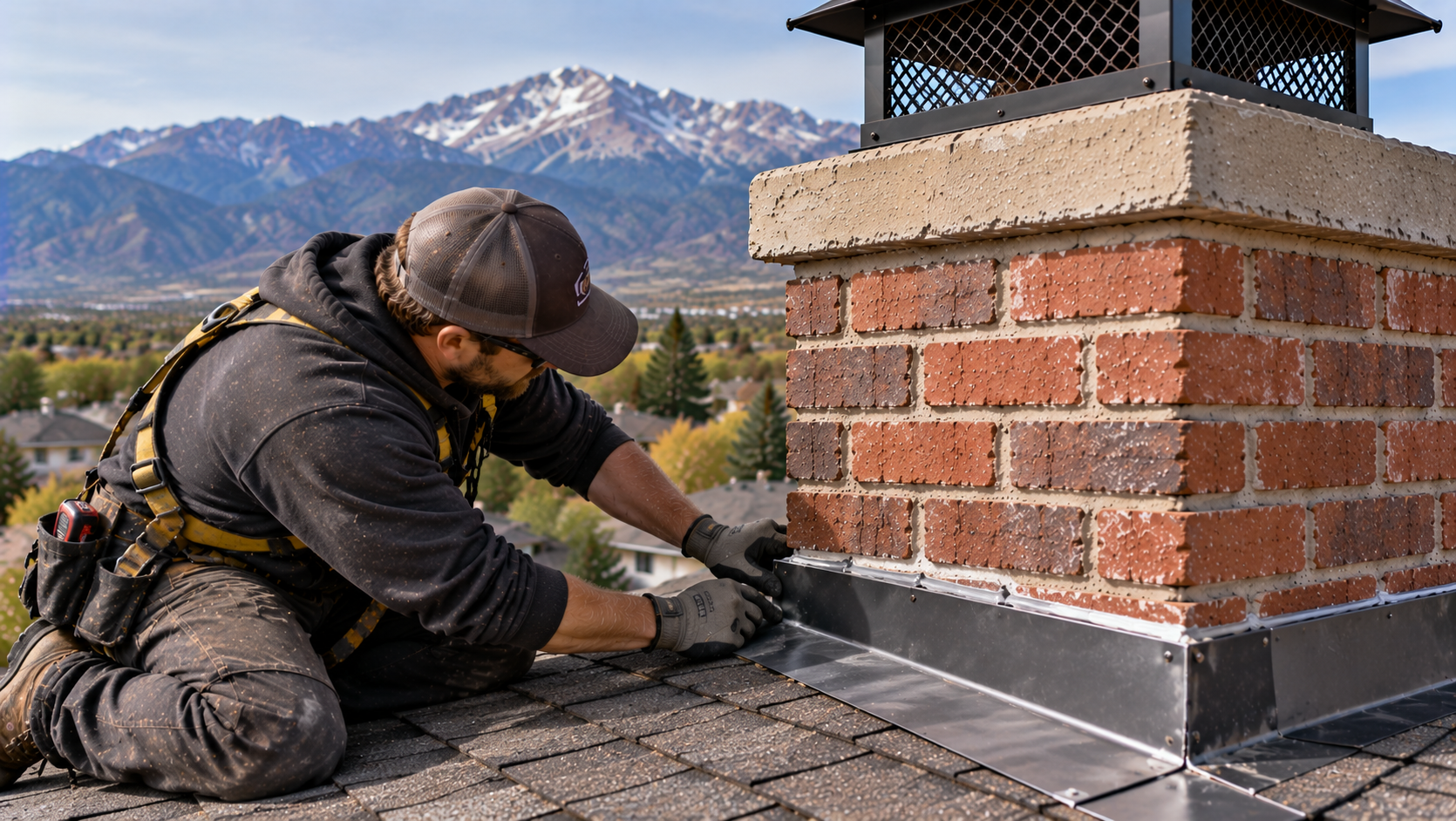
Chimney Flashing Repair Stops the Leak Where It Actually Starts
Most ceiling stains near a fireplace aren't roof failures. They're flashing failures.
The flashing is the system of metal pieces installed where your chimney meets the roof. When that seal breaks - and in Colorado Springs, it breaks faster than most places - water finds the path of least resistance straight into your home.
Getting it repaired correctly means addressing both the metal and the masonry connection, not just one or the other.
30-50°Temperature change within a single day
Colorado Springs Puts Flashing Under More Stress Than Most Cities Do
Colorado Springs temperature swings are the leading cause of chimney flashing failure on the Front Range.
Here's what most homeowners don't realize about flashing in this climate. Colorado Springs regularly sees temperature changes of 30 to 50 degrees within a single day - especially in fall and spring. That's not an extreme weather event here. That's a Tuesday in October.
Every time the temperature swings, your metal flashing expands and contracts. Counter flashing - the metal pieces embedded directly into the chimney mortar joint - takes the hardest hit. That mortar joint is rigid. The metal wants to move. Over seasons, that tension pulls the counter flashing loose, opening a gap at the reglet - the slot cut into the masonry where the flashing is embedded and sealed.
Our office on Fountain Boulevard puts crews close to the neighborhoods where this plays out most often. The older roof stocks in Stratmoor, Security-Widefield, and Fountain see consistent flashing wear. Properties along the Palmer Divide corridor face elevated wind exposure that accelerates the same process. These aren't hypothetical failure points - they're what we document on inspections every season.
I Traced a Ceiling Stain Back 14 Inches to a Quarter-Inch Flashing Gap
Water travels far before it shows up - chimney flashing failures rarely reveal themselves at the source.From our lead technician on a recent Colorado Springs job
I got called to a house in Security-Widefield. The homeowner had a water stain on the drywall about three feet to the left of the fireplace, close to where the ceiling meets the wall. She'd already had a roofing company out twice. Both times, they didn't find anything wrong with the shingles.
- 1The step flashing looked fineI started at the roofline. The step flashing - the individual L-shaped metal pieces installed in courses alongside the chimney, each overlapping the one below and interlocking with the shingles - looked intact from the ground.
- 2The counter flashing had liftedBut once I got up there, I found the counter flashing had pulled away from the reglet on the uphill face of the chimney. The gap was less than a quarter inch. You wouldn't spot it walking past. That gap was the entry point.
- 314 inches across the deckWater from snowmelt was running under the counter flashing, hitting the roof deck, and traveling laterally about 14 inches before it dropped. This is called roof deck water intrusion - water that enters at the flashing seam and migrates before it surfaces as a visible stain.
- 4Then the ceilingThat's why it showed up feet away from the chimney inside the house. She'd been chasing the wrong problem for two years.
The fix wasn't roofing work. It was re-embedding the counter flashing into a clean reglet, re-sealing with a flexible, UV-stable sealant rated for Colorado's temperature range, and resetting the step flashing courses on the uphill side. Once we fixed the actual source, the stain dried up and never came back.
This chimney also happened to be wide - over 30 inches across the back face. We flagged that it needed a chimney cricket (also called a saddle), a peaked structure built behind wide chimneys to divert water and debris around the uphill side rather than letting it pool and freeze against the masonry. That was a separate conversation, but it was part of the complete picture.
Why the Masonry Connection Matters as Much as the Metal
Replacing the metal without re-securing the masonry connection leaves the same gap open.
A common question goes like this: "Can you just caulk it?" Sometimes, yes - flashing sealant failure, the cracking or shrinkage of the flexible sealant between counter flashing and masonry, is the first failure point, and early-stage cracks can be addressed without a full replacement. But here's the honest answer about when that's enough.
Sealant-only repair works when the flashing is still fully seated in the reglet and the metal itself hasn't deformed. The moment the counter flashing has lifted - even slightly - re-caulking over a displaced piece just bridges an air gap. It lasts one winter, maybe two.
Our approach is to assess the reglet first. If the flashing has pulled out of the mortar joint, it gets re-embedded properly before any sealant goes on. That's the difference between a repair that lasts and one that needs to be redone every other season.
Sealant-only works when
- Flashing is still fully seated in the reglet
- The metal hasn't deformed
- Sealant cracks are early-stage
Re-caulking lifted flashing
- Just bridges an air gap
- Lasts one winter, maybe two
- Needs redoing every other season
Our Standards for Chimney Flashing Repair in Colorado Springs
Every flashing repair we do addresses both the metal and the masonry - no half-measures.
- Step flashing assessment first: We check every course of step flashing - those L-shaped metal pieces - for deformation, rust, and seal integrity before addressing counter flashing.
- Counter flashing re-embedding: If the counter flashing has pulled from the reglet, we re-cut or clean the mortar joint and re-embed the metal properly. No bridging over a gap with sealant alone.
- Cricket evaluation on wide chimneys: Any chimney over 30 inches gets assessed for whether a chimney cricket - the peaked saddle that redirects water away from the uphill face - is needed or already present and functional.
- Sealant rated for thermal movement: We use flexible, UV-stable sealant products rated to handle the Colorado Springs temperature range - not standard caulk that stiffens and cracks within two seasons.
- CSIA-certified diagnostics: Flashing condition is assessed as part of a documented chimney system evaluation by CSIA-certified technicians, not a standalone visual check.
- Full documentation: Every repair is photographed before and after so you can see exactly what was done and why.
The repair process has three phases - diagnostic, correction, and verification.
How We Execute Chimney Flashing Repair
Starting at the Ceiling, Not the Roofline
We start at the ceiling stain, not the roofline. Understanding where water surfaces inside helps us trace the travel path backward. Then we move to the roof. We check the step flashing courses, the counter flashing seating at the reglet, and the sealant line along the mortar joint. On chimneys wider than 30 inches, we evaluate the uphill face for pooling evidence and assess whether a chimney cricket is needed. We also check for thermal expansion movement - the repeated dimensional change metal undergoes across temperature cycles - to assess how far the counter flashing has migrated from its original position. A quarter-inch gap means one thing. A half-inch means another.
Making the Repair Hold
If sealant-only repair is appropriate, we clean the joint, apply the correct product, and tool it properly for adhesion. If the counter flashing has pulled from the reglet, we re-embed it. That means cleaning the slot, re-seating the metal, and sealing with a product built for thermal movement. Step flashing courses that have lifted or deformed get reset. We don't leave adjacent courses in place if they show the same wear pattern - that's just rework waiting to happen. Cricket installation, when needed, is a separate scope item that gets discussed and quoted before any work begins.
Confirming the Work Before We Leave
We run a controlled water test from the roofline after every flashing repair. This confirms the seal is holding before we leave the property. We document the result and walk the homeowner through what was repaired and what to watch for. If anything indicates a wider chimney system issue - like mortar joint deterioration that contributed to the reglet failure - we note it in writing.
Areas We Serve Near Colorado Springs
We handle chimney flashing repair throughout the greater Colorado Springs area.
- Colorado Springs
- Stratmoor
- Security-Widefield
- Fountain
- Rockrimmon
- Briargate
- Cimarron Hills
- Falcon
- Black Forest
- Manitou Springs
- Monument
- Pueblo
- Pueblo West
- Canon City
- Woodland Park
- Divide
- Castle Rock
- Parker
- Denver
Our crews serve Colorado Springs neighborhoods including Stratmoor, Security-Widefield, Fountain, Rockrimmon, Briargate, Cimarron Hills, Falcon, and Black Forest. We also cover Manitou Springs, Monument, Pueblo, Pueblo West, Canon City, Woodland Park, Divide, Castle Rock, Parker, and Denver. Call (720) 505-5030 to confirm coverage for your address.
Ready to Fix the Source of That Ceiling Stain?
Chimney flashing repair in Colorado Springs starts with a diagnostic call to (720) 505-5030.
The stain on your ceiling has a specific source - and in most cases, it's the flashing, not the roof. We'll trace it, confirm it, and repair it correctly the first time. Call (720) 505-5030 or email info@chimneysweepscoloradosprings.com to schedule your flashing assessment. Ask for the next available Colorado Springs crew.
Frequently Asked Questions
Call and talk to the team directly.
Call (720) 505-5030Specific pricing depends on whether step flashing, counter flashing, or both need attention. Call (720) 505-5030 for a diagnostic quote. Wide chimneys requiring a cricket saddle are quoted as a separate scope item before any work begins.
Sealant-only repair works only when the counter flashing is still fully seated in the reglet. If the metal has lifted - even slightly - caulking over a displaced piece bridges an air gap. That lasts one or two winters at most. We assess the reglet first. Re-embedding comes before any sealant goes on.
Most flashing repairs complete in a single visit, typically two to four hours. That includes diagnostic tracing, counter flashing re-embedding or sealant correction, step flashing reset where needed, and a controlled water test before we leave. Jobs requiring a chimney cricket installation are scoped and scheduled separately.
Step flashing is the set of L-shaped metal pieces layered alongside the chimney with each shingle course. Counter flashing is the metal embedded into the chimney mortar joint that overlaps the step flashing below. Colorado Springs temperature swings pull counter flashing loose at the mortar joint far more often. Our inspection checks both before any repair decision is made.
Roofers inspect shingles - chimney flashing is a masonry-to-metal system they rarely assess in full. Water enters at the reglet gap, travels laterally along the roof deck, and surfaces feet away from the actual failure point. That travel distance is exactly why the leak looks like a roofing problem. CSIA-certified diagnostics trace the path from the stain back to the source.
Every repair addresses both the metal and the mortar joint connection - not just one or the other. Replacing flashing metal without re-securing the counter flashing into a properly cut and sealed reglet leaves the identical failure point open. Our CSIA-certified technicians document the reglet condition before and after, with photos provided at job completion.