
Smoke Chamber Repair in Colorado Springs - Corbeled & Parged Surfaces
Smoke Chamber Repaired and Cured Before Your First Fall Fire
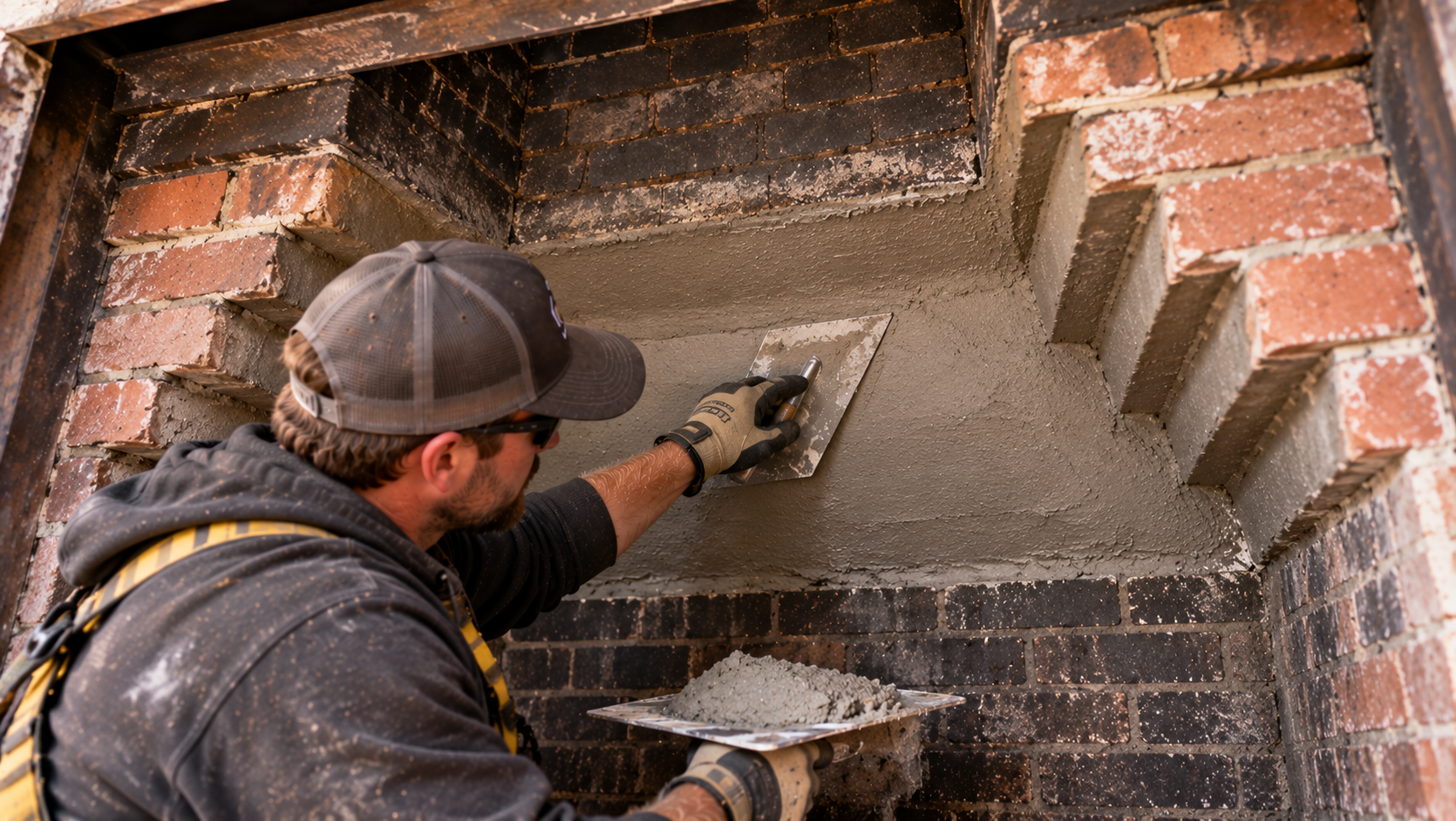
Refractory parge coat applied by CSIA-certified technicians on every repair
- CSIA-certified technicians
- Refractory mortar only
- Cured before first use
What Smoke Chamber Repair Actually Fixes
A restored smoke chamber pulls smoke up into the flue - every time you light a fire.
The smoke chamber - the funnel-shaped cavity sitting directly above your fireplace damper - is responsible for one critical job. It compresses combustion gases and accelerates them from the wide firebox opening into the narrower flue above.
That transition zone is everything. When it works correctly, you don't think about it. When the surface inside is rough or deteriorating, smoke slows down right at that bottleneck. That's when smoke rollout occurs - the condition where smoke exits the firebox into the living space instead of drawing upward.
A smooth parge coat - a layer of refractory mortar applied to the interior chamber walls - is what makes that transition work. It removes drag, seals the surface, and holds up through years of thermal cycling when the right material is used.
Smoke chamber parge coat work in Colorado Springs addresses that surface directly. No workaround. No cleaning fix. Just the repair the chamber actually needs.
OctRepair before it, cured before the first hard freeze
Colorado Springs Masonry Homes and the Corbeling Problem
Older Colorado Springs neighborhoods have the highest concentration of rough corbeled smoke chambers in the region.
Here's what most homeowners don't realize about corbeled construction. The brick courses that form the smoke chamber walls step inward in rough, irregular layers - structurally sound, but aerodynamically rough. That stair-step surface catches soot and combustion residue far more aggressively than a smooth surface does.
Older Colorado Springs neighborhoods - Stratmoor Hills, Old Colorado City, Broadmoor - have a dense stock of masonry fireplace homes, including many built in the 1960s and 1970s. Many of those smoke chambers were either never parged at all, or received a coat that has since cracked and flaked. The raw corbeling sits exposed.
Colorado's dry climate and dramatic temperature swings accelerate parge coat failure. A chamber that sees a cold November morning and a roaring fire the same afternoon is cycling through significant thermal stress. Freeze-thaw conditions in shoulder seasons - March and October especially - push that stress harder on any surface already beginning to separate.
Chimney smoke chamber restoration in Colorado Springs accounts for that cycle. Getting the repair done before October means it cures fully before the first hard freeze.
What the Surface Tells You Before Any Other Test
Inspecting a smoke chamber in Colorado Springs starts at the damper frame and works upward.
Every job we run dispatches from our E Fountain Blvd location. When we're working a chimney smoke chamber restoration in Colorado Springs - whether in Broadmoor or Black Forest - the assessment starts at the damper frame and moves upward through the chamber.
Surface condition is documented with photographs through the firebox before work begins. That documentation stays with the job record.
- 1Start at the damper frameThe assessment starts at the damper frame and moves upward through the chamber.
- 2DelaminationThe first check is parge coat condition. The inspection looks for delamination - sections of the coat that have lifted away from the corbeled brick beneath.
- 3Cracks at the corbel stepsOpen cracks along the corbel steps, where brick courses change angle, are also documented. That's where thermal stress concentrates.
- 4The smoke shelfCorbeling, parge coat adhesion, structural cracks, and smoke shelf condition are all documented. The smoke shelf is addressed if surface damage extends to that zone.
- 5Resurface or remove firstIf the existing coat is sound but thinning, the scope is a resurfacing job. If delamination covers multiple zones, loose material comes out before any new coat goes down. Applying new material over a compromised surface transfers the failure point - it doesn't eliminate it.
Homes built during the 1960s and 1970s Colorado Springs construction boom frequently received a standard masonry mix for parging - not a refractory formulation. It looked fine initially. Standard mortar isn't rated for direct combustion exposure, so it softens, shrinks, and cracks faster than a heat-rated mix. By the time a homeowner calls, that original coat has often been failing slowly for several seasons.
One Material Makes the Difference on Every Repair
Refractory mortar - not standard masonry mix - is the only material rated for smoke chamber parging.
Refractory mortar is a heat-rated formulation designed to withstand the direct thermal cycling of combustion. Standard masonry mortar is not. That distinction matters more than application technique.
A parge coat applied with the wrong material cracks within one or two burn seasons. The chamber returns to rough, exposed corbeling - and the homeowner is back to the same symptoms.
We follow code requirements and the refractory manufacturer's specifications on every application. Our technicians are CSIA certified - the Chimney Safety Institute of America trains technicians on how smoke chambers should be built and repaired, and that training shapes how they assess chambers and specify repairs at every job.
The coat goes on in the correct thickness. Then it cures. The fireplace stays out of service during the curing window.
Refractory mortar
- Heat-rated for direct combustion exposure
- Holds up through years of thermal cycling
- Keeps the chamber smooth
Standard masonry mortar
- Not rated for direct combustion exposure
- Softens, shrinks, and cracks
- Fails within one or two burn seasons
Our Smoke Chamber Repair Standards and Process
Every parge coat repair follows a documented sequence - no skipped steps, no substituted materials.
- Refractory parge mortar rated for direct combustion contact - not standard masonry mix
- Surface preparation includes removal of all delaminated and loose existing coat before new material is applied
- Application inspected for uniform coverage across corbeled surfaces and smoke shelf
- Thickness maintained to specification - not feathered thin at transitions
- Curing period observed per the refractory manufacturer's guidelines before return to service
- Post-cure visual check performed before the job is closed
The repair sequence runs from inspection to cure - with no shortcuts at any stage.
How a Smoke Chamber Repair Gets Executed
Diagnostics First
The technician accesses the smoke chamber through the firebox opening. Surface condition is assessed and photographed. Corbeling, parge coat adhesion, structural cracks, and smoke shelf condition are all documented. The repair scope is defined before any material is ordered.
Refractory Application
Loose or delaminated parge coat is removed. The corbeled surface is cleaned and prepared. Refractory mortar is applied in consistent passes, covering all corbeled steps and transitions. The smoke shelf is addressed if surface damage extends to that zone. The technician checks coverage from multiple angles through the firebox.
Cure and Return to Service
After the curing window closes, the fireplace is inspected visually before being returned to service. Draft transition zone performance can be assessed with a smoke test on request. Any surface concerns noted during the cure period are addressed before the job record is closed.
Colorado Springs Neighborhoods We Serve
Smoke chamber parge coat service covers the full Colorado Springs metro and surrounding communities.
- Colorado Springs
- Stratmoor Hills
- Old Colorado City
- Broadmoor
- Rockrimmon
- Briargate
- Falcon
- Black Forest
- Manitou Springs
- Monument
- Fountain
- Security-Widefield
- Woodland Park
- Divide
- Pueblo
- Castle Rock
- Parker
We dispatch from our E Fountain Blvd location in Colorado Springs. Service runs across Stratmoor Hills, Old Colorado City, Broadmoor, Rockrimmon, Briargate, Falcon, Black Forest, Manitou Springs, and Monument. We also serve Fountain, Security-Widefield, Woodland Park, Divide, Pueblo, Castle Rock, Parker, and the full Pikes Peak Region.
Schedule Your Smoke Chamber Assessment
A working smoke chamber means smoke stays where it belongs - inside the flue, not the room.
Call 720-505-5030 or email info@chimneysweepscoloradosprings.com to schedule your smoke chamber repair assessment in Colorado Springs. Tell us what you're seeing - smoke rollout, visible cracks, draft problems - and we'll dispatch a CSIA-certified technician. Don't wait until fire season is already underway.
Frequently Asked Questions
Call and talk to the team directly.
Call (720) 505-5030Pricing for smoke chamber parging depends on chamber condition, extent of delamination, and whether loose material requires full removal before reapplication. Contact Chimney Sweep Colorado Springs at 720-505-5030 for an assessment-based estimate.
A clean flue doesn't fix a damaged smoke chamber. The chamber is the transition zone directly above the damper. When its parge coat cracks or flakes away, rough corbeled brick creates drag that slows smoke before it ever reaches the flue. Cleaning removes deposits - it doesn't resurface that cavity.
Refractory mortar is heat-rated for direct combustion exposure. Standard masonry mortar softens, shrinks, and cracks within one or two burn seasons when used inside a smoke chamber. Using the wrong material means the repair fails fast - and the chamber returns to the same rough, draft-disrupting surface.
Application typically takes two to four hours depending on chamber condition and surface preparation required. The fireplace stays out of service during the full curing window after the parge coat is applied. Rushing that window risks cracking the fresh coat before it sets.
Only delaminated and loose sections are removed. Solid, well-adhered existing coat in good condition can stay. Applying new refractory mortar over compromised sections just transfers the failure point - so loose material always comes out first. A CSIA-certified technician documents surface condition before any removal begins.
Yes. The technician evaluates corbeling structure, smoke shelf condition, and damper frame during the same access. Structural cracks along corbel steps, shelf debris buildup, and damper seal issues are all documented. Surface photos are taken through the firebox before work begins and kept with the job record.